Rolling out the strategies according to plan, but behind schedule.
Things got very busy at the day job. There was a major grant application that took up a lot of the organization's bandwidth, contributing to a lag of several weeks since my last post.
During that time I've been moving forward with the first strategy, of targeted outreach. After pitching Dr. Bednarz to a slew of graduate student groups at Columbia's Mailman School of Public Health, and contacts at the New School and NYU, I have one interested group, and am simply waiting to see if they proceed. I pitched The Nation Magazine on one or more local events to tie into their online video series, but they weren't interested.
The second strategy - grassroots organizing around appealing sustainability initiatives - is less paradigm changing, but easier to make progress with. Here are the ways it plugs into the larger goals discussed on this blog:
- There are many civic groups that don't see themselves as sustainability advocates, but who can transmit very green initiatives into far-reaching local networks - if they see where those initiatives further their own agendas.
- City level green initiatives can always use some promotional support.
- Positioning oneself on the edge of City level initiatives, and neighborhood networks who could potentially adopt them, allows the social change entrepreneur to offer value to both groups. Permaculture people will recognize the potential of edges within ecosystems.
- This work can develop a growing community of contacts who can be educated about still more sustainability initiatives.
- More crucially, that community can eventually be educated about why sustainability initiatives will be increasingly necessary. However, it will be very counterproductive to raise those topics prematurely.
So, focusing on the NYC CoolRoofs program, I've done a few things. Working closely with the program staff, who operate out of the NYC Department of Buildings, I put together a seven page memo that explains in great detail exactly how commercial building owners and nonprofits can get the City to paint their roofs white, what they have to put in, and what they get from the City or other partners. It also serves as a marketing piece for commercial building owners. It's always good to be able to talk about lowering electric bills, and free labor to apply the white paint.
They care only about whether and how they financially benefit from the program, and would be distressed or offended if any appeal so much as mentioned climate change response. My research revealed that white roof coating of older NYC commercial / industrial buildings, with little insulation and black tar roofs, that are only one or two stories tall, will pay for the cost of the white paint in three years or less. I'll target that appeal first to Long Island City commercial building owners that I know well, and then to larger lists. If that service doesn't appeal, and the opportunity presents itself, I'll tell smaller electricity users about Con Ed's free energy efficiency survey, and its 70% discounts on many upgrades.
To encourage western Queens nonprofits and civic groups to step forward and get their roofs coated, the appeal is partly about lowering air conditioning bills, but more about being perceived as a neighborhood leader. The full memo on how to work the NYC CoolRoofs program is available on request.
Tuesday, February 22, 2011


Monday, January 17, 2011
Progressive magazine The Nation launches Peak Oil video series
The Nation, a leading progressive publication, has taken a highly visible stand on peak oil. On January 5, 2011, The Nation announced that it would post a series of videos about peak oil and climate change from its website.
"The scientific community has long agreed that our dependence on fossil fuels inflicts massive damage on the environment and our health, while warming the globe in the process. But beyond the damage these fuels cause to us now, what will happen when the world's supply of oil runs out?
Peak Oil is the point at which petroleum production reaches its greatest rate just before going into perpetual decline. In “Peak Oil and a Changing Climate,” a new video series from The Nation and On The Earth productions, radio host Thom Hartmann explains that the world will reach peak oil within the next year if it hasn’t already. As a nation, the United States reached peak oil in 1974, after which it became a net oil importer.
Bill McKibben, Noam Chomsky, Nicole Foss, Richard Heinberg and the other scientists, researchers and writers interviewed throughout “Peak Oil and a Changing Climate” describe the diminishing returns our world can expect as it deals with the consequences of peak oil even as it continues to pretend it doesn’t exist. These experts predict substantially increased transportation costs, decreased industrial production, unemployment, hunger and social chaos as the supplies of the fuels on which we rely dwindle and eventually disappear.
Chomsky urges us to anticipate the official response to peak oil based on how corporations, news organizations and other institutions have responded to global warming: obfuscation, spin and denial. James Howard Kunstler says that we cannot survive peak oil unless we “come up with a consensus about reality that is consistent with the way things really are.” This documentary series hopes to help build that consensus. Click here to watch the introductory video, and check back here for new videos each Wednesday."
Here's the first video, with Noam Chomsky, Richard Heinberg, Bill McKibben, Nicole Foss, Thom Hartmann, Dmitry Orlov, and Jim Kunstler.
The second video is all Richard Heinberg. As he says, our economy is only designed to operate under continuous growth. Without continuously increasing energy supplies, economic growth as we've known it won't be possible, especially under current economic and debt burdens. And it's not just peak oil, it's all the nonrenewable resources on which we depend: coal, uranium, rare earth metals...it's peak everything. As more of the original resource is used up, more and more energy and cash are required to extract the ever smaller amounts that are left behind. Politicians won't want to acknowledge the end of growth. They'll stick to pleasant falsehoods about how business as usual can be extended indefinitely, as long as they can, so we can't depend on them. Eventually we'll have to accept constraints and adopt serious lifestyle changes, and to get to that point, we'll need grassroots organizing: getting people to ask, what can we do as citizens?
For an iconic progressive media outlet like The Nation to acknowledge resource depletion is a major step forward. Since financial and political elites have succeeded in putting the urgency of climate change in doubt for many Americans, we have to talk about sustainability in terms of climate change, fuel depletion, and economic transformation, all at the same time. Even stunningly misled Americans will higher oil prices and oil shortages seriously.
Likely? No, certain. Our top sources for imported oil, by the way, are: Canada, Mexico, Saudi Arabia, Venezuela and Nigeria. Most of Canadian oil is inefficiently squeezed from oil sands. Production from Cantarell, Mexico's major oil field, is dropping quickly, and will inevitably reduce what we can hope to import from what's currently our #2 import source. You get the idea.
Let's help the Nation get this video series out. Please visit their website, and forward links to your friends.
I contacted The Nation with the following proposal. After that is a big quote from Lindsay Curran's great article on how peak oil could save the Obama Presidency.
***
January 10, 2011
Re: The Nation’s new video series on peak oil and climate change
Dear -----
I am writing to heartily congratulate the Nation for its bold and farsighted new video series, in collaboration with Thom Hartmann, on peak oil and climate change. By forthrightly addressing fuel depletion, the Nation has leaped far ahead of the majority of environmental, sustainability and progressive organizations.
I would like to propose that the Nation capitalize on its leadership position by cosponsoring a series of NYC presentations, addressing the local implications of issues raised in the series. Look at how NYC was affected by slow snow removal after the recent blizzard. How would oil price spikes or shortages affect operation of municipal vehicles, trucks, or mass transit, to give just a few examples?...
This series would bring together leading national experts, along with a panel of local experts, to discuss fuel depletion and local impacts and responses. Events could focus on themes like transportation, job creation, urban revitalization, or food. I am currently organizing such an event with Dan Bedarz, PhD, on how to make public health and medical institutions more resilient to resource and financial constraints.
Here are some benefits to the Nation and the larger community:
(1) The Nation will promote its leadership within the national progressive community to NYC's concentrated population of progressive readers, thinkers and activists - all of whom are potential subscribers or website visitors.
(2) The Nation can build partnerships with NYC progressive networks, and should this initiative succeed and be replicated, within other major cities
(3) As the Nation’s own description states, the series hopes to build a reality-based consensus for a national response to peak oil. Co-sponsoring presentations would promote the series, and the Nation’s goals for its broader effect.
(4) Bringing fuel depletion into the national discussion will provide an opportunity for progressives and President Obama to regain the initiative, and influence the 2012 election.
As Lindsay Curran writes, by forthrightly addressing peak oil, President Obama can put out a tangible and compelling narrative around which to rally the people. International Energy Agency's 2010 World Energy Outlook, which officially admits world oil production peaked in 2006, will give Obama all the cover he needs. If he’s willing to present peak oil in full detail, Obama can turn the entire conservative narrative upside down. He can call for an emergency effort to prepare America for the end of cheap oil, and create domestic jobs in energy, transportation and manufacturing, as a matter of national security. Spreading this message widely in the progressive community can give the Obama Administration and other politicians the push they need. An aggressive effort to promote the Nation’s series could be pivotal.
The Nation should seize this opportunity to make the most of its farsighted progressive leadership, for its readers, the City, and the country. I would be glad to assist or advise the Nation on such a project. Please contact me at ....
***
Peak oil could save Obama's PresidencyThe increasingly common view is that America is a nation in decline. Peak oil blogger Lindsay Curran says Obama has an pportunity to address it forthrightly and turn things around, by putting out a compelling narrative around which to rally the people When Obama keeps ignoring the elephant in the room—peak oil— he also fails to grasp a way out of the mess in which he and the nation is stuck. A vague and undirected "hope for change" has much less to offer than one with an identifiable target to aim for or a predicament to address, says Curran. This is such an important point that I'll quote extensively from his article.
"Fortunately, the International Energy Agency's 2010 World Energy Outlook gives cover to any top-tier politician or candidate who wishes to bring the issue to the table. Effectively he or she can take the approach that, "It's not my idea, it's the IEA's assessment."
How could peak oil play the hero in breaking political gridlock while motivating American enthusiasm? Well, nothing else is working, for one. So, what is there to lose with a Hail Mary pass? Second, leveling with people after a long period of obfuscation and avoidance itself can help break long-festering tensions and restore trust.
Look at what's been been said by every American president of the last nearly 40 years—the old "fossil fuels are running out and we need an energy independent solution" refrain. In response to which, what has been done? Nothing. Nothing has been done...Finally, exposing a true predicament while also offering a viable and optimistic strategy to address that predicament creates myriad opportunities for hope to morph into vision and vision into strategy....
But when Obama meets with these CEOs he should forget about job creation in the predictable areas. Forget the same-old same-old cars-and-highways paradigm. It isn't working and it has no real future in the wake of peak oil. Forget GM and Detroit unless they're diversifying and going into new projects such as rail cars, hybrid vehicles, and solar and wind parts for other infrastructure. Forget expanding oil and gas. These are sunset industries.
Instead, Obama should focus on sunrise areas. Here's my three-point plan:
1.Call for a full throttle effort to prepare America for a world beyond cheap oil. Present it as competition with China, as Energy Secretary Steven Chu has dubbed it, "America's Sputnik Moment." Lay out in stark and unforgiving terms just what's at stake if America grows any more inert. Call it a straight path to that spectral decline. By speaking boldly and directly about the implications of peak oil on American quality of life, the president can pose infrastructure renewal and build-out, particularly in rail, as a way to protect the home front. But the president must explicitly present all these improvements as a direct response to peak oil. He needs to tell the public that if we don't undertake this project, we're going to be twisting in the wind in 30 years. Guaranteed. Then he must use every ounce of the bully pulpit to drive it home. America dealt with the Civil War, and World Wars I and II, so we can deal with this, too. We have it in us. In fact, we almost need it.
2.Work with industry to create domestic manufacturing jobs in both energy and transportation but also in textiles, steel and consumer products. Dealing with distributed power, conservation efforts and transportation will bolster national security and connect our transport networks on land in order to be poised for the time when distance costing money will mean the real end to significant global trade. In the post peak economy (long before 2030) distance will cost money and we'll be so glad those folks are back to work and those goods are available here. Alternatively we could let ourselves become China's bitch, grateful for 20-cents-an-hour jobs making the products for the growing appetite of middle-class consumers in Shanghai. It's our choice.
3.Create a vocal culture of encouragement surrounding relocalized economies, so that regional areas remain vibrant by making and exporting specialty local goods both abroad and within the US. Encourage local farming, smaller scale production, smaller scale clean energy production and local transit solutions. Follow the American people's leadership on the desire to shop locally and lessen stress. Bring back Buy American! This isn't protectionism. It's survival. Revival.
Together, these three bold responses will create jobs, spur the right kind of growth, and lift the leaden eyes of a downcast population toward the vision of a new paradigm, one they sense and that more than a few long for. How are we going to pay for it? Let's figure it out.
And what's the alternative, besides the abyss? Should we embrace instead going full scale into dirtier oil, mountaintop removal in spades, more coal fired plants, and war, war, war? The other alternative is illusion, and with it, sure decline. If not now, when?
Spit it out, already!
As long as the president is afraid to say the words peak oil, he's got nothing to rally the nation around. Everything else we've heard so far from the White House or seen in the news is just too vague. But in contrast to something like global warming, an invisible and amorphous threat that's all too easy to deny or ignore, everybody can understand that oil is a finite resource. Obama got close to this in his Gulf oil spill speech, but then dropped the ball. It's time to pick it back up again and make a bee line for the basket.
We can't turn a finite resource into an infinite one, however much wishful thinking we apply to it. And however much business and other interested parties try to deny the reality of peak oil in order to achieve their own interests— short term personal profits, the long arc of American success be damned—there is no more time to waste.
Every driver understands the price at the gas pumps. Those prices are rising, and with it, so are food prices. The jobless are crying out for relief. All that pain needs an explanation. Peak oil is not a hard story to tell. And moreover, it's as true as the sunrise this morning.
Once Obama uses that bully pulpit to his advantage, lays out the case on peak oil, and invokes competition with China for conservation and clean energy solutions as crucial to reviving our national purpose and drive, he'll get somewhere. Then he must not let up.
And who doesn't love the prospect of solar panels? Who doesn't love the romance of the train, especially while surfing YouTube and reading your email, free from the burden of driving?
Look, ten years of green marketing has laid the groundwork. The people are ready. Now if the leader steps out in front and rides the tail wind, we'll maybe get somewhere.
The detractors can yell from the sidelines all they want. But the people will be relieved that at last America is not pussyfooting around any more. Fear of the diagnosis is the only thing in our way. First you cry, then you get on with it.
It's standard political messaging, President Obama. You start the conversation, you own it. Don't get stuck playing defense; make the other side respond to your bold initiatives. Then, they're playing on your quadrant and you're on top.
We can talk illegal immigrants and anchor babies in 2012. Or we can talk jobs now.
"The scientific community has long agreed that our dependence on fossil fuels inflicts massive damage on the environment and our health, while warming the globe in the process. But beyond the damage these fuels cause to us now, what will happen when the world's supply of oil runs out?
Peak Oil is the point at which petroleum production reaches its greatest rate just before going into perpetual decline. In “Peak Oil and a Changing Climate,” a new video series from The Nation and On The Earth productions, radio host Thom Hartmann explains that the world will reach peak oil within the next year if it hasn’t already. As a nation, the United States reached peak oil in 1974, after which it became a net oil importer.
Bill McKibben, Noam Chomsky, Nicole Foss, Richard Heinberg and the other scientists, researchers and writers interviewed throughout “Peak Oil and a Changing Climate” describe the diminishing returns our world can expect as it deals with the consequences of peak oil even as it continues to pretend it doesn’t exist. These experts predict substantially increased transportation costs, decreased industrial production, unemployment, hunger and social chaos as the supplies of the fuels on which we rely dwindle and eventually disappear.
Chomsky urges us to anticipate the official response to peak oil based on how corporations, news organizations and other institutions have responded to global warming: obfuscation, spin and denial. James Howard Kunstler says that we cannot survive peak oil unless we “come up with a consensus about reality that is consistent with the way things really are.” This documentary series hopes to help build that consensus. Click here to watch the introductory video, and check back here for new videos each Wednesday."
Here's the first video, with Noam Chomsky, Richard Heinberg, Bill McKibben, Nicole Foss, Thom Hartmann, Dmitry Orlov, and Jim Kunstler.
The second video is all Richard Heinberg. As he says, our economy is only designed to operate under continuous growth. Without continuously increasing energy supplies, economic growth as we've known it won't be possible, especially under current economic and debt burdens. And it's not just peak oil, it's all the nonrenewable resources on which we depend: coal, uranium, rare earth metals...it's peak everything. As more of the original resource is used up, more and more energy and cash are required to extract the ever smaller amounts that are left behind. Politicians won't want to acknowledge the end of growth. They'll stick to pleasant falsehoods about how business as usual can be extended indefinitely, as long as they can, so we can't depend on them. Eventually we'll have to accept constraints and adopt serious lifestyle changes, and to get to that point, we'll need grassroots organizing: getting people to ask, what can we do as citizens?
For an iconic progressive media outlet like The Nation to acknowledge resource depletion is a major step forward. Since financial and political elites have succeeded in putting the urgency of climate change in doubt for many Americans, we have to talk about sustainability in terms of climate change, fuel depletion, and economic transformation, all at the same time. Even stunningly misled Americans will higher oil prices and oil shortages seriously.
Likely? No, certain. Our top sources for imported oil, by the way, are: Canada, Mexico, Saudi Arabia, Venezuela and Nigeria. Most of Canadian oil is inefficiently squeezed from oil sands. Production from Cantarell, Mexico's major oil field, is dropping quickly, and will inevitably reduce what we can hope to import from what's currently our #2 import source. You get the idea.
Let's help the Nation get this video series out. Please visit their website, and forward links to your friends.
I contacted The Nation with the following proposal. After that is a big quote from Lindsay Curran's great article on how peak oil could save the Obama Presidency.
***
January 10, 2011
Re: The Nation’s new video series on peak oil and climate change
Dear -----
I am writing to heartily congratulate the Nation for its bold and farsighted new video series, in collaboration with Thom Hartmann, on peak oil and climate change. By forthrightly addressing fuel depletion, the Nation has leaped far ahead of the majority of environmental, sustainability and progressive organizations.
I would like to propose that the Nation capitalize on its leadership position by cosponsoring a series of NYC presentations, addressing the local implications of issues raised in the series. Look at how NYC was affected by slow snow removal after the recent blizzard. How would oil price spikes or shortages affect operation of municipal vehicles, trucks, or mass transit, to give just a few examples?...
This series would bring together leading national experts, along with a panel of local experts, to discuss fuel depletion and local impacts and responses. Events could focus on themes like transportation, job creation, urban revitalization, or food. I am currently organizing such an event with Dan Bedarz, PhD, on how to make public health and medical institutions more resilient to resource and financial constraints.
Here are some benefits to the Nation and the larger community:
(1) The Nation will promote its leadership within the national progressive community to NYC's concentrated population of progressive readers, thinkers and activists - all of whom are potential subscribers or website visitors.
(2) The Nation can build partnerships with NYC progressive networks, and should this initiative succeed and be replicated, within other major cities
(3) As the Nation’s own description states, the series hopes to build a reality-based consensus for a national response to peak oil. Co-sponsoring presentations would promote the series, and the Nation’s goals for its broader effect.
(4) Bringing fuel depletion into the national discussion will provide an opportunity for progressives and President Obama to regain the initiative, and influence the 2012 election.
As Lindsay Curran writes, by forthrightly addressing peak oil, President Obama can put out a tangible and compelling narrative around which to rally the people. International Energy Agency's 2010 World Energy Outlook, which officially admits world oil production peaked in 2006, will give Obama all the cover he needs. If he’s willing to present peak oil in full detail, Obama can turn the entire conservative narrative upside down. He can call for an emergency effort to prepare America for the end of cheap oil, and create domestic jobs in energy, transportation and manufacturing, as a matter of national security. Spreading this message widely in the progressive community can give the Obama Administration and other politicians the push they need. An aggressive effort to promote the Nation’s series could be pivotal.
The Nation should seize this opportunity to make the most of its farsighted progressive leadership, for its readers, the City, and the country. I would be glad to assist or advise the Nation on such a project. Please contact me at ....
***
Peak oil could save Obama's PresidencyThe increasingly common view is that America is a nation in decline. Peak oil blogger Lindsay Curran says Obama has an pportunity to address it forthrightly and turn things around, by putting out a compelling narrative around which to rally the people When Obama keeps ignoring the elephant in the room—peak oil— he also fails to grasp a way out of the mess in which he and the nation is stuck. A vague and undirected "hope for change" has much less to offer than one with an identifiable target to aim for or a predicament to address, says Curran. This is such an important point that I'll quote extensively from his article.
"Fortunately, the International Energy Agency's 2010 World Energy Outlook gives cover to any top-tier politician or candidate who wishes to bring the issue to the table. Effectively he or she can take the approach that, "It's not my idea, it's the IEA's assessment."
How could peak oil play the hero in breaking political gridlock while motivating American enthusiasm? Well, nothing else is working, for one. So, what is there to lose with a Hail Mary pass? Second, leveling with people after a long period of obfuscation and avoidance itself can help break long-festering tensions and restore trust.
Look at what's been been said by every American president of the last nearly 40 years—the old "fossil fuels are running out and we need an energy independent solution" refrain. In response to which, what has been done? Nothing. Nothing has been done...Finally, exposing a true predicament while also offering a viable and optimistic strategy to address that predicament creates myriad opportunities for hope to morph into vision and vision into strategy....
But when Obama meets with these CEOs he should forget about job creation in the predictable areas. Forget the same-old same-old cars-and-highways paradigm. It isn't working and it has no real future in the wake of peak oil. Forget GM and Detroit unless they're diversifying and going into new projects such as rail cars, hybrid vehicles, and solar and wind parts for other infrastructure. Forget expanding oil and gas. These are sunset industries.
Instead, Obama should focus on sunrise areas. Here's my three-point plan:
1.Call for a full throttle effort to prepare America for a world beyond cheap oil. Present it as competition with China, as Energy Secretary Steven Chu has dubbed it, "America's Sputnik Moment." Lay out in stark and unforgiving terms just what's at stake if America grows any more inert. Call it a straight path to that spectral decline. By speaking boldly and directly about the implications of peak oil on American quality of life, the president can pose infrastructure renewal and build-out, particularly in rail, as a way to protect the home front. But the president must explicitly present all these improvements as a direct response to peak oil. He needs to tell the public that if we don't undertake this project, we're going to be twisting in the wind in 30 years. Guaranteed. Then he must use every ounce of the bully pulpit to drive it home. America dealt with the Civil War, and World Wars I and II, so we can deal with this, too. We have it in us. In fact, we almost need it.
2.Work with industry to create domestic manufacturing jobs in both energy and transportation but also in textiles, steel and consumer products. Dealing with distributed power, conservation efforts and transportation will bolster national security and connect our transport networks on land in order to be poised for the time when distance costing money will mean the real end to significant global trade. In the post peak economy (long before 2030) distance will cost money and we'll be so glad those folks are back to work and those goods are available here. Alternatively we could let ourselves become China's bitch, grateful for 20-cents-an-hour jobs making the products for the growing appetite of middle-class consumers in Shanghai. It's our choice.
3.Create a vocal culture of encouragement surrounding relocalized economies, so that regional areas remain vibrant by making and exporting specialty local goods both abroad and within the US. Encourage local farming, smaller scale production, smaller scale clean energy production and local transit solutions. Follow the American people's leadership on the desire to shop locally and lessen stress. Bring back Buy American! This isn't protectionism. It's survival. Revival.
Together, these three bold responses will create jobs, spur the right kind of growth, and lift the leaden eyes of a downcast population toward the vision of a new paradigm, one they sense and that more than a few long for. How are we going to pay for it? Let's figure it out.
And what's the alternative, besides the abyss? Should we embrace instead going full scale into dirtier oil, mountaintop removal in spades, more coal fired plants, and war, war, war? The other alternative is illusion, and with it, sure decline. If not now, when?
Spit it out, already!
As long as the president is afraid to say the words peak oil, he's got nothing to rally the nation around. Everything else we've heard so far from the White House or seen in the news is just too vague. But in contrast to something like global warming, an invisible and amorphous threat that's all too easy to deny or ignore, everybody can understand that oil is a finite resource. Obama got close to this in his Gulf oil spill speech, but then dropped the ball. It's time to pick it back up again and make a bee line for the basket.
We can't turn a finite resource into an infinite one, however much wishful thinking we apply to it. And however much business and other interested parties try to deny the reality of peak oil in order to achieve their own interests— short term personal profits, the long arc of American success be damned—there is no more time to waste.
Every driver understands the price at the gas pumps. Those prices are rising, and with it, so are food prices. The jobless are crying out for relief. All that pain needs an explanation. Peak oil is not a hard story to tell. And moreover, it's as true as the sunrise this morning.
Once Obama uses that bully pulpit to his advantage, lays out the case on peak oil, and invokes competition with China for conservation and clean energy solutions as crucial to reviving our national purpose and drive, he'll get somewhere. Then he must not let up.
And who doesn't love the prospect of solar panels? Who doesn't love the romance of the train, especially while surfing YouTube and reading your email, free from the burden of driving?
Look, ten years of green marketing has laid the groundwork. The people are ready. Now if the leader steps out in front and rides the tail wind, we'll maybe get somewhere.
The detractors can yell from the sidelines all they want. But the people will be relieved that at last America is not pussyfooting around any more. Fear of the diagnosis is the only thing in our way. First you cry, then you get on with it.
It's standard political messaging, President Obama. You start the conversation, you own it. Don't get stuck playing defense; make the other side respond to your bold initiatives. Then, they're playing on your quadrant and you're on top.
We can talk illegal immigrants and anchor babies in 2012. Or we can talk jobs now.
Saturday, January 8, 2011
Making public health sustainable and resilient
NYC is a big place, with lots of stuff going on, and people talking all at once: a challenging place to advance new ideas at the best of times. In an earlier post on this blog, I set out the theory that the larger discussion of preparing NYC for the future can be positively influenced by planting innovative ideas in very specialized networks and communities.
There are many such networks. It's not just the upper echelons of the Bloomberg administration and Wall Street financiers. Local networks include academic organizations, trade and professional associations, bloggers and online columnists with large readerships, and religious communities. Don't forget civic organizations with diverse neighborhood links and participants. John Michael Greer has encouraged sustainability activists to join fraternal organizations, like the Masonic Lodge, Kiwanis Club or Rotary, which used to be major players in American culture.
How to pick a network, and work through it to influence a larger community?
- The network would have to be small enough, and publicly accessible enough, so a handful of cultural activists could identify and contact their gatekeepers.
- The network has to be sufficiently important to the operations of the larger community so discussions within it quickly diffuse into other powerful networks.
- The innovative material to be presented is critical enough to the interests of the network to be relevant to its gatekeepers, and just provocative enough to be interesting, without crossing into red zones.
- If the material presents taboo topics or dire consequences, or violates any of countless subtle social norms, automatic shut-off circuits will be activated, resulting in both the material and the messenger being ignored.
- If the material presents potential responses that offer hope, as well as the risks, and if the responses promised to mitigate other problems already acknowledged within the network, or advanced some elements of the network's agendas - then, the material might be taken up within the network.
Applying the approach to NYC's health and medical community
One of the best people to do this is public health expert Dan Bednarz, whose articles appear frequently in Energy Bulletin. As he explains, our current health care system will have to adapt to constraints, and he sets out ways of doing it. I proposed introducing him to decision makers within this NYC network. We came up with a draft proposal letter similar to this...
***
How can we make NYC health institutions both more sustainable and more resilient?
We are arranging NYC presentations by Dan Bednarz, PhD, in spring 2011, and are seeking multiple co-sponsors. The public health and medical communities have not yet been sufficiently engaged in the Bloomberg Administration’s PlaNYC 2030 groundbreaking effort to address climate change and sustainability. As a leading expert on these questions, Dr. Bednarz can stimulate your colleagues to enter the PlaNYC discussion.
He can tailor presentations for physicians and hospital executives about countering threats to the sustainability of current medical systems, or help public health administrators redesign systems to reduce dependence on government funding by increasing community participation and using trained volunteers to disseminate public health information.
As co-editor of Health after Oil, Dr. Bednarz coordinates research and discussions on how healthcare institutions can respond to the unprecedented challenges of rising population pressures, increasingly limited energy supplies, climate change, and the economic disruptions now impacting health care budgets at all levels. He advocates for sustainability strategies that incorporate cost cutting and preventive health care as well as traditional environmental concerns – making this a win-win approach for executives and administrators.
At the invitation of special editor Howie Frumkin, former head of the CDC Center for Environmental Health, Dr. Bednarz, Jeremy Hess, MD and Jessica Pierce, PhD, have submitted “The Health Care System and Petroleum Scarcity” to The American Journal of Public Health for its forthcoming focus issue on peaking petroleum,.
Because modern health care is fundamentally dependent on petroleum, particularly for transport of patients, staff, and supplies, and for pharmaceuticals feedstocks, it is vulnerable to price fluctuations, cost spikes, and scarcity of raw materials. The article will address how health systems can prepare for service disruptions and related sustainability challenges.
Starting March 2011, Dr. Bednarz will be teaching an online course on Sustainable Public Health Systems through Bristol Community College. It will cover how to create a viable 21st century public health system, to reconfigure systems and become more resilient to declining state and local tax bases by developing a new public policy context with a synergistic relationship between professionals and local communities.
Would your organization be interested in co-sponsoring a presentation by Dr. Bednarz on these themes? If so, do you have an easily accessible lecture hall in Manhattan at which this could take place? To raise these topics in the NYC medical and public health community, Dr. Bednarz is able to make such presentations without requiring an honorarium.
Dr. Bednarz can also collaborate on internships and research projects for graduate students in public health, in which interns inventory resilience and sustainability challenges in public health systems, design ecologically sustainable system responses, and build consortiums across health sciences and professions.
***
Next, I'll contact some local medical and public health schools, and see if I can find a graduate student to do an internship on this project.
Beyond Oil NYC's experiment in open source activism has room for you. If you think this campaign makes sense, your assistance in distributing the message would be most helpful. I do this stuff for my nonprofit day job all the time, so I can guide volunteers through each step.
Keep it manageable: think of the hospital or health care institution that serves your community. Go to its website. Find the contact information for its senior executives and community affairs contacts. Customize the above letter and email it. Follow up by phone to describe the project. It's a great project for current or would-be graduate students, and those between jobs. Contact Beyond Oil NYC.
Monday, December 27, 2010
Encouraging Anthony Weiner’s role as angry prophet
Encouraging Anthony Weiner’s role as angry prophet
My Congressman, Anthony Weiner, does not need any encouragement to forthrightly speak his mind. Google him, and you’ll quickly discover Weiner's brief but memorable speech from July 30, 2010. Talking Points memo gives both the background, and a link to the video.
The House was debating a bill last night that would provide up to $7.4 billion in health care aid to rescue and recovery workers who have faced health problems since their work in the wake of the September 11 attacks. The bill ultimately failed to get the needed two-thirds majority, 255-159, and Rep. Anthony Weiner (D-NY) was not happy about it. Not one bit.
In a rant that lasted for almost two minutes, a hopping mad Weiner railed against "cowardly" Republicans who claimed they were voting against the bill because of "procedure." Weiner spat: "It's Republicans wrapping their arms around Republicans, rather than doing the right thing on behalf of the heroes!"
Weiner attacked those who "stand up and say, 'Oh, if only we had a different process we'd vote yes.' You vote yes if you believe yes! You vote in favor of something if you believe it's the right thing! If you believe it's the wrong thing, you vote no!"
"It is a shame! A shame," he exclaimed.
Political theorist Andrew Bard Schmookler thinks Weiner’s talent for fiery rhetoric can be put to greater use. Schmookler, the creator and author of the website NoneSoBlind.org, has a Ph.D. in history, and has written several books on political psychology, ethics & culture. He’s been a commentator on National Public Radio's "All Things Considered,” and is a go-to call-in guest on radio shows, in both blue and red states, on the controversial issues of the moment. One of Schmookler’s readers knows that I live in Weiner’s district, and put me in touch with him. After some discussion, I walked a full version of the proposal you’re about to read, in hard copy, to Weiner’s district office.
Lately, Schmookler has been musing in his blog about the need for a progressive champion. Ideally, this would be President Obama, but it’s been a lot of water under the bridge since the 2008 appeals for hope and change. (You can already see where this is going, right?)
Schmookler summarizes a number of his articles here, but I’ll put it in a nutshell for you. America’s governing forces and elites habitually lie in ways that reveal “an arrogant and dangerous disregard of the need to respect reality.” These amoral ruling forces are rapidly dismantling the structures that have protected goodness and decency. They have succeeded in deceiving many good Americans. The situation can easily become much worse.
The American people urgently need to recognize and repudiate both the leaders, and those dark aspects of the American culture that they have embodied. Many American liberals have a hard time with that job, because they have a moral blind spot. Many are unable to recognize that evil is a real concept, and how profound the distinction between good and evil is. Liberals are unable to connect with and articulate their deep moral values.
Schmookler says we need "a prophetic social movement that speaks moral truth about amoral power in such a way as to awaken our traditionalist countrymen from the trance state into which their leaders have put them."
A comeback strategy for progressive champions
When a conflict on some important issue emerges between Obama and the Republicans, Schmookler suggests, the President should challenge to the Republicans to debate the issue on national television. Frame it explicitly in terms of what’s best for the country. Whether the Republicans fail to accept the debate, or defend their position, which will tend to overlap with those of wealthy, corporate interests, the dark reality of so-called conservatism will be revealed. Obama can reissue this challenge over and over. If the Republicans refuse to debate, Obama can give a talk to the nation comparing his and the Republican proposals. Obama sometimes seems conflict-averse, but he is a very good debater, and with solid positions to defend, is likely to do well. As a way of further anchoring the debates to objective reality, Schmookler suggests including a panel of experts, who can instantly respond to disputed matters of fact. The panelists would be selected impartially by the most respected professional groups in their field, such as the National Academy of Sciences, or the American Bar Association.
What if Obama prefers bipartisanship over confrontation?
It’s possible that President Obama might refuse this role as too confrontational, and damaging to his efforts at bipartisanship. In this case, shouldn't progressive national leaders find someone willing to step up, and turn around the momentum for 2012? Rep. Bernie Sanders is capable of the job, but as the Independent (socialist) Congressman from Vermont, can't represent the Democrats on the national stage. They need someone in a safe seat, with a very aggressive temperment. Weiner might be the right man for the job. Which is why I paid a visit to his Kew Gardens office last week.
A respectable tradition of angry prophets
Maybe I should have asked Schmookler about this. How accurate is the sterotype of the Old Testament prophet as full of rage on behalf of God against the moral decline of the people, calling for repentence? Wikipedia suggests it's right on target:
In his book The Prophets, Abraham Joshua Heschel describes the unique aspect of the Jewish prophets as compared to other similar figures. Whereas other nations have soothsayers and diviners who attempt to discover the will of their gods, according to Heschel the Hebrew prophets are characterized by their experience of what he calls theotropism — God turning towards humanity. Heschel argues for the view of Hebrew prophets as receivers of the "Divine Pathos," of the wrath and sorrow of God over his nation that has forsaken him.
He writes: "Prophecy is the voice that God has lent to the silent agony, a voice to the plundered poor, to the profane riches of the world. It is a form of living, a crossing point of God and man. God is raging in the prophet's words. (The Prophets Ch. 1)"
We have a lot to be angry about. Some of us are capable of channelling prophetic anger on a regular basis, in an inspiring, effective way. Jon Stewart and Stephen Colbert are able to hide their anger in a matrix of humor.
James Howard Kunstler blogs about peak oil and the collapse of the funny money economy. He's darkly funny, although without Stewart and Colbert's extraordinary comedic gifts or capacity for mirth. I go to his site every Monday morning.
Some contemporary versions of the prophetic archetype - eloquent, very angry, and not funny at all - are Keith Olberman and William Rivers Pitt from Truthout. So are Bill McKibben, James Hansen, and Anthony Weiner. They perform a valuable function, and as Schmookler points out, we need to crank up the volume on our societal prophecy speakers. So please support your favorite prophets, your local prophets, and your own call to prophecy, whatever it may be.
My Congressman, Anthony Weiner, does not need any encouragement to forthrightly speak his mind. Google him, and you’ll quickly discover Weiner's brief but memorable speech from July 30, 2010. Talking Points memo gives both the background, and a link to the video.
The House was debating a bill last night that would provide up to $7.4 billion in health care aid to rescue and recovery workers who have faced health problems since their work in the wake of the September 11 attacks. The bill ultimately failed to get the needed two-thirds majority, 255-159, and Rep. Anthony Weiner (D-NY) was not happy about it. Not one bit.
In a rant that lasted for almost two minutes, a hopping mad Weiner railed against "cowardly" Republicans who claimed they were voting against the bill because of "procedure." Weiner spat: "It's Republicans wrapping their arms around Republicans, rather than doing the right thing on behalf of the heroes!"
Weiner attacked those who "stand up and say, 'Oh, if only we had a different process we'd vote yes.' You vote yes if you believe yes! You vote in favor of something if you believe it's the right thing! If you believe it's the wrong thing, you vote no!"
"It is a shame! A shame," he exclaimed.
Political theorist Andrew Bard Schmookler thinks Weiner’s talent for fiery rhetoric can be put to greater use. Schmookler, the creator and author of the website NoneSoBlind.org, has a Ph.D. in history, and has written several books on political psychology, ethics & culture. He’s been a commentator on National Public Radio's "All Things Considered,” and is a go-to call-in guest on radio shows, in both blue and red states, on the controversial issues of the moment. One of Schmookler’s readers knows that I live in Weiner’s district, and put me in touch with him. After some discussion, I walked a full version of the proposal you’re about to read, in hard copy, to Weiner’s district office.
Lately, Schmookler has been musing in his blog about the need for a progressive champion. Ideally, this would be President Obama, but it’s been a lot of water under the bridge since the 2008 appeals for hope and change. (You can already see where this is going, right?)
Schmookler summarizes a number of his articles here, but I’ll put it in a nutshell for you. America’s governing forces and elites habitually lie in ways that reveal “an arrogant and dangerous disregard of the need to respect reality.” These amoral ruling forces are rapidly dismantling the structures that have protected goodness and decency. They have succeeded in deceiving many good Americans. The situation can easily become much worse.
The American people urgently need to recognize and repudiate both the leaders, and those dark aspects of the American culture that they have embodied. Many American liberals have a hard time with that job, because they have a moral blind spot. Many are unable to recognize that evil is a real concept, and how profound the distinction between good and evil is. Liberals are unable to connect with and articulate their deep moral values.
Schmookler says we need "a prophetic social movement that speaks moral truth about amoral power in such a way as to awaken our traditionalist countrymen from the trance state into which their leaders have put them."
A comeback strategy for progressive champions
When a conflict on some important issue emerges between Obama and the Republicans, Schmookler suggests, the President should challenge to the Republicans to debate the issue on national television. Frame it explicitly in terms of what’s best for the country. Whether the Republicans fail to accept the debate, or defend their position, which will tend to overlap with those of wealthy, corporate interests, the dark reality of so-called conservatism will be revealed. Obama can reissue this challenge over and over. If the Republicans refuse to debate, Obama can give a talk to the nation comparing his and the Republican proposals. Obama sometimes seems conflict-averse, but he is a very good debater, and with solid positions to defend, is likely to do well. As a way of further anchoring the debates to objective reality, Schmookler suggests including a panel of experts, who can instantly respond to disputed matters of fact. The panelists would be selected impartially by the most respected professional groups in their field, such as the National Academy of Sciences, or the American Bar Association.
What if Obama prefers bipartisanship over confrontation?
It’s possible that President Obama might refuse this role as too confrontational, and damaging to his efforts at bipartisanship. In this case, shouldn't progressive national leaders find someone willing to step up, and turn around the momentum for 2012? Rep. Bernie Sanders is capable of the job, but as the Independent (socialist) Congressman from Vermont, can't represent the Democrats on the national stage. They need someone in a safe seat, with a very aggressive temperment. Weiner might be the right man for the job. Which is why I paid a visit to his Kew Gardens office last week.
A respectable tradition of angry prophets
Maybe I should have asked Schmookler about this. How accurate is the sterotype of the Old Testament prophet as full of rage on behalf of God against the moral decline of the people, calling for repentence? Wikipedia suggests it's right on target:
In his book The Prophets, Abraham Joshua Heschel describes the unique aspect of the Jewish prophets as compared to other similar figures. Whereas other nations have soothsayers and diviners who attempt to discover the will of their gods, according to Heschel the Hebrew prophets are characterized by their experience of what he calls theotropism — God turning towards humanity. Heschel argues for the view of Hebrew prophets as receivers of the "Divine Pathos," of the wrath and sorrow of God over his nation that has forsaken him.
He writes: "Prophecy is the voice that God has lent to the silent agony, a voice to the plundered poor, to the profane riches of the world. It is a form of living, a crossing point of God and man. God is raging in the prophet's words. (The Prophets Ch. 1)"
We have a lot to be angry about. Some of us are capable of channelling prophetic anger on a regular basis, in an inspiring, effective way. Jon Stewart and Stephen Colbert are able to hide their anger in a matrix of humor.
James Howard Kunstler blogs about peak oil and the collapse of the funny money economy. He's darkly funny, although without Stewart and Colbert's extraordinary comedic gifts or capacity for mirth. I go to his site every Monday morning.
Some contemporary versions of the prophetic archetype - eloquent, very angry, and not funny at all - are Keith Olberman and William Rivers Pitt from Truthout. So are Bill McKibben, James Hansen, and Anthony Weiner. They perform a valuable function, and as Schmookler points out, we need to crank up the volume on our societal prophecy speakers. So please support your favorite prophets, your local prophets, and your own call to prophecy, whatever it may be.
Sunday, December 12, 2010
The role of grassroots sustainability organizing
Summary: After the midterm election, selling climate change got even tougher than it was before. Since the NYC sustainability discussion is mainly framed as climate change response, civic and business leaders should expand it to include the more marketable concepts of increasing resilience, and preparing for higher and more volatile energy prices. Those price changes are coming in the next five years, acccording to sources including the US military and the International Energy Agency, but NYC isn't talking about them, let alone preparing for them. In this post and the next, two parallel strategies to change that are set out, based on the time-honored principle of WIFM - "what's in it for me?" First, highly targeted outreach to networks of thought leaders, on how their fields will benefit from initiatives that conserve energy, lower costs and build local resiliency. Second, outreach to NYC civic networks on behalf of appealing sustainability projects that offer something to all participants. Volunteers and collaborators will be invited.
***
The role of grassroots sustainability organizing
Changing the sustainability discussion is important, as a means of getting people involved in practical, effective efforts to make their communities more sustainable. Discussion must lead to action. Otherwise, mere talk, no matter how well informed and well intentioned, is cheap.
Many activists responded to failure of national and international climate change legislation by turning to decentralized grassroots action. Joining the invitation from 350.org to a global work party on 10/10/10, people at over 7,000 events in 188 countries, got to work on the climate crisis. By digging community gardens, installing solar panels, planting trees and more, they aimed to send a message to political leaders: “if we can get to work, so can you!”
This is clearly informed by the Transition method of community organizing, now being applied in many UK towns and cities, as described in the New York Times. Neighbors educate themselves about climate change and fuel depletion, envision their community having successfully adapted twenty years in the future, and then work backward, planning what needs to be done to make that future possible. Collaborating on local projects, participants begin creating that future piece by piece.
In large cities, environmental and sustainability groups organize presentations and films all the time, but without recruiting partners who live in close proximity, and who share permanent social networks. However, many city residents are very involved in neighborhood concerns through countless civic groups.
Seeking happy attractors
Can sustainability initiatives be distributed through well-established local networks? Perhaps – if one can find initiatives appealing enough to inspire different sets of volunteers, who usually operate in different realms, to collaborate. What initiatives might fill this role? What initiatives offer enough benefits to be easily sold, implemented, duplicated and expanded? What will motivate environmental activists, neighborhood leaders, and additional volunteers and partners? The initiative must:
- inspire climate change and sustainability activists to volunteer themselves and promote it to others;
- offer clear cost benefits or savings, without considering environmental benefits;
- be easy to understand, describe, and see as positive;
- must be quick, inexpensive, and simple enough so volunteers can dive in and successfully accomplish projects, inspiring others to follow; and
- must offer enough public relations benefits to local partners and civic groups so that they have an incentive to expedite these projects.
One comparatively simple way to lower the City’s air conditioning use in the summer happens to fit all these requirements. It is a happy attractor: there is nothing distressing about it; it is empowering, patriotic, and it distributes goodies all around with minimal cost. It offends no one, has no enemies, and is welcome at parties. It is a great conversation starter. If you can think of other programs like this, please let us know immediately!
Painting roofs white
Black surfaces absorb more of the sun’s heat than white surfaces. Each summer, NYC’s many flat, black tar roofs can get up to 100 degrees hotter than outdoor air temperatures, increasing the amount of air conditioning required to cool the building below. This means more energy used, more carbon emissions, more pressure on the City’s already strained electric grid, and higher risk of blackouts. By radiating that heat to their surroundings, black roofs contribute to the heat island effect, whereby urban areas can reach temperatures up to 15% hotter than surrounding rural areas.
White roof coating projects are an important part of NYC’s climate change response, with the NYC Cool Roofs program. “Reflective rooftops are a simple yet powerful tool in the fight we have been leading against climate change,” said Mayor Bloomberg, and a means to channel “the power of our volunteers to address some of the City’s greatest needs.” U.S. Energy Secretary Steven Chu has called for “white roofs everywhere” to help fight climate change.

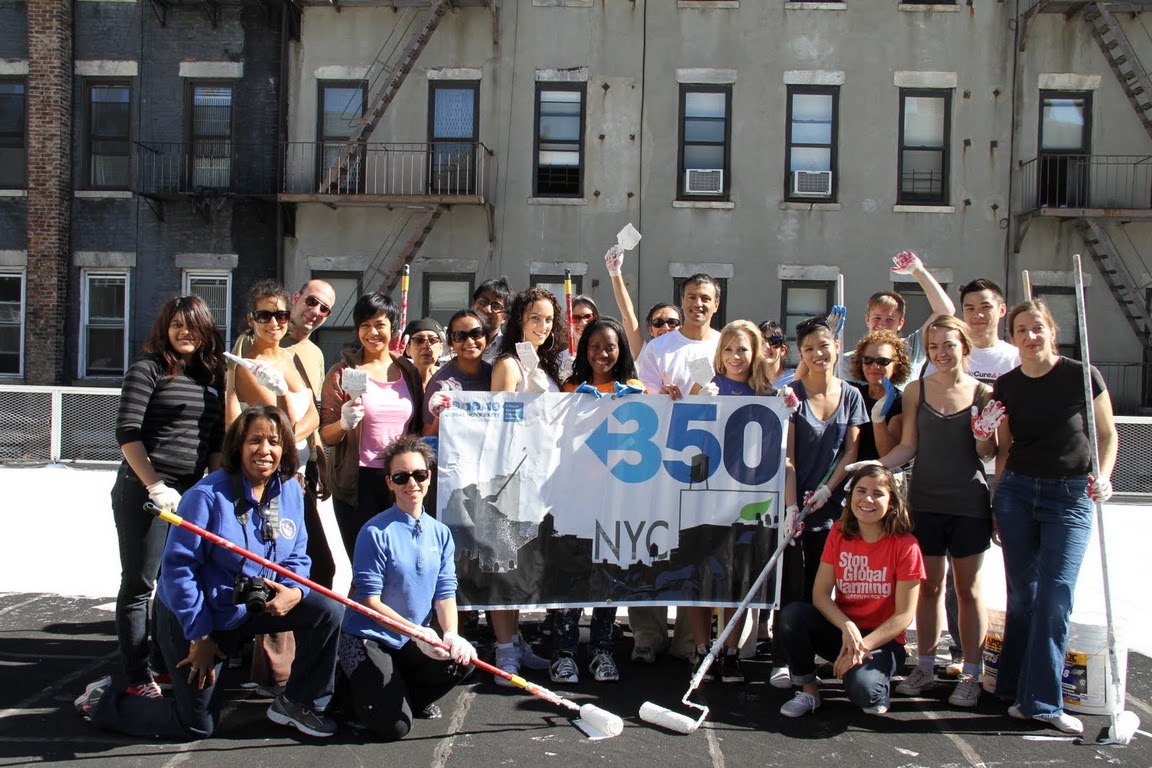
In the fall of 2010, inspired by 350.org’s 10/10/10 Global Work Party, several groups collaborated with NYC government agencies to paint the roofs of four nonprofit facilities white: the Bowery Mission, Harlem’s Democracy Prep Charter School, Fountain House in midtown Manhattan, and the SCO Ottillie Campus in Briarwood, Queens. Organizers and volunteers came from StopOilNYC, White Roof Campaign, White Roof Project, Manhattan Young Democrats, 350.org, Greenpeace, OxFam, NYPIRG, and New York University student environmental groups.
Projects like these will not only make real improvements in lowering energy use, but can help recruit more partners and volunteers, and set up other local sustainability initiatives. To find potential nonprofit facilities with roofs to paint in 2011, we’ll start with the Council Members we contacted who were eager to refer us to nonprofits in their districts.

The matter of paying for the paint creates an opportunity. Instead of seeking corporate donations, we’ll work with the nonprofit to organize winter events to raise the money locally. Besides gaining local supporters and media attention, these projects allow environmentalists from outside the neighborhood to wield rollers and brushes alongside volunteers from within it.
For the full proposal for neighborhood leaders, and flyers from the City Cool Roofs program, go to www.whiteroofcampaign.org/ or Beyond Oil NYC.
Green neighborhood Trojan horses
With positive relationships already established between organizers and the nonprofit contacts seeking to fund their white roof project, we can introduce the next stage of the project. What are the overlaps between community needs, and the green services that are already available in the City but not adequately distributed? Usually centered on promotion of energy efficiency programs, government agencies regularly set up panels at which representatives pitch several programs to neighborhood leaders and residents.
- Are energy bills too high? Con Edison and NYSERDA, the State agency which incentivizes energy efficiency retrofits, offer a number of cost-cutting energy efficiency upgrades for homes and businesses.
- Do neighbors want more fresh fruits and vegetables in local stores? Green markets? Many nonprofits offer gardening classes, and want to help residents convert lawns and yards into vegetable gardens, and set up community gardens and composting areas.
- Are there complaints about inadequate mass transit service? Let’s find the advocates and alternatives who can address this community need.
- Job training providers, for both green and conventional programs.
- Food assistance and public health programs for those in need.
White roof project organizers can introduce community leaders to these other programs, making their outreach efforts easier, and reinforcing the new green network forming within the neighborhood.
This might work something like a Transition initiative. Here, the organizing process would start, not with a common education process around climate change and fuel depletion, but with unthreatening projects that have something to offer a broad range of participants. Should the ingredients come together – and external events reinforce the importance of more sustainable and resilient neighborhoods – the project may be able to recruit more volunteers, develop a network, and evolve in other productive directions.
Some questions on which you might like to comment:
Would you like to intern, volunteer or collaborate with a white roof project?
Are there happy attractors and green Trojan horses better than white roof painting?
Or ones that you like better that you would like to collaborate on with us?
What's going on with Transition initiatives in the United States, and what can we learn from them about how to make NYC more sustainable?
***
The role of grassroots sustainability organizing
Changing the sustainability discussion is important, as a means of getting people involved in practical, effective efforts to make their communities more sustainable. Discussion must lead to action. Otherwise, mere talk, no matter how well informed and well intentioned, is cheap.
Many activists responded to failure of national and international climate change legislation by turning to decentralized grassroots action. Joining the invitation from 350.org to a global work party on 10/10/10, people at over 7,000 events in 188 countries, got to work on the climate crisis. By digging community gardens, installing solar panels, planting trees and more, they aimed to send a message to political leaders: “if we can get to work, so can you!”
This is clearly informed by the Transition method of community organizing, now being applied in many UK towns and cities, as described in the New York Times. Neighbors educate themselves about climate change and fuel depletion, envision their community having successfully adapted twenty years in the future, and then work backward, planning what needs to be done to make that future possible. Collaborating on local projects, participants begin creating that future piece by piece.
In large cities, environmental and sustainability groups organize presentations and films all the time, but without recruiting partners who live in close proximity, and who share permanent social networks. However, many city residents are very involved in neighborhood concerns through countless civic groups.
Seeking happy attractors
Can sustainability initiatives be distributed through well-established local networks? Perhaps – if one can find initiatives appealing enough to inspire different sets of volunteers, who usually operate in different realms, to collaborate. What initiatives might fill this role? What initiatives offer enough benefits to be easily sold, implemented, duplicated and expanded? What will motivate environmental activists, neighborhood leaders, and additional volunteers and partners? The initiative must:
- inspire climate change and sustainability activists to volunteer themselves and promote it to others;
- offer clear cost benefits or savings, without considering environmental benefits;
- be easy to understand, describe, and see as positive;
- must be quick, inexpensive, and simple enough so volunteers can dive in and successfully accomplish projects, inspiring others to follow; and
- must offer enough public relations benefits to local partners and civic groups so that they have an incentive to expedite these projects.
One comparatively simple way to lower the City’s air conditioning use in the summer happens to fit all these requirements. It is a happy attractor: there is nothing distressing about it; it is empowering, patriotic, and it distributes goodies all around with minimal cost. It offends no one, has no enemies, and is welcome at parties. It is a great conversation starter. If you can think of other programs like this, please let us know immediately!
Painting roofs white
Black surfaces absorb more of the sun’s heat than white surfaces. Each summer, NYC’s many flat, black tar roofs can get up to 100 degrees hotter than outdoor air temperatures, increasing the amount of air conditioning required to cool the building below. This means more energy used, more carbon emissions, more pressure on the City’s already strained electric grid, and higher risk of blackouts. By radiating that heat to their surroundings, black roofs contribute to the heat island effect, whereby urban areas can reach temperatures up to 15% hotter than surrounding rural areas.
White roof coating projects are an important part of NYC’s climate change response, with the NYC Cool Roofs program. “Reflective rooftops are a simple yet powerful tool in the fight we have been leading against climate change,” said Mayor Bloomberg, and a means to channel “the power of our volunteers to address some of the City’s greatest needs.” U.S. Energy Secretary Steven Chu has called for “white roofs everywhere” to help fight climate change.

In the fall of 2010, inspired by 350.org’s 10/10/10 Global Work Party, several groups collaborated with NYC government agencies to paint the roofs of four nonprofit facilities white: the Bowery Mission, Harlem’s Democracy Prep Charter School, Fountain House in midtown Manhattan, and the SCO Ottillie Campus in Briarwood, Queens. Organizers and volunteers came from StopOilNYC, White Roof Campaign, White Roof Project, Manhattan Young Democrats, 350.org, Greenpeace, OxFam, NYPIRG, and New York University student environmental groups.
Projects like these will not only make real improvements in lowering energy use, but can help recruit more partners and volunteers, and set up other local sustainability initiatives. To find potential nonprofit facilities with roofs to paint in 2011, we’ll start with the Council Members we contacted who were eager to refer us to nonprofits in their districts.
For the full proposal for neighborhood leaders, and flyers from the City Cool Roofs program, go to www.whiteroofcampaign.org/ or Beyond Oil NYC.
Green neighborhood Trojan horses
With positive relationships already established between organizers and the nonprofit contacts seeking to fund their white roof project, we can introduce the next stage of the project. What are the overlaps between community needs, and the green services that are already available in the City but not adequately distributed? Usually centered on promotion of energy efficiency programs, government agencies regularly set up panels at which representatives pitch several programs to neighborhood leaders and residents.
- Are energy bills too high? Con Edison and NYSERDA, the State agency which incentivizes energy efficiency retrofits, offer a number of cost-cutting energy efficiency upgrades for homes and businesses.
- Do neighbors want more fresh fruits and vegetables in local stores? Green markets? Many nonprofits offer gardening classes, and want to help residents convert lawns and yards into vegetable gardens, and set up community gardens and composting areas.
- Are there complaints about inadequate mass transit service? Let’s find the advocates and alternatives who can address this community need.
- Job training providers, for both green and conventional programs.
- Food assistance and public health programs for those in need.
White roof project organizers can introduce community leaders to these other programs, making their outreach efforts easier, and reinforcing the new green network forming within the neighborhood.
This might work something like a Transition initiative. Here, the organizing process would start, not with a common education process around climate change and fuel depletion, but with unthreatening projects that have something to offer a broad range of participants. Should the ingredients come together – and external events reinforce the importance of more sustainable and resilient neighborhoods – the project may be able to recruit more volunteers, develop a network, and evolve in other productive directions.
Some questions on which you might like to comment:
Would you like to intern, volunteer or collaborate with a white roof project?
Are there happy attractors and green Trojan horses better than white roof painting?
Or ones that you like better that you would like to collaborate on with us?
What's going on with Transition initiatives in the United States, and what can we learn from them about how to make NYC more sustainable?
Sunday, November 21, 2010
NYC sustainability in a time of climate change, resource depletion and financial disruption
Summary: After the midterm election, selling climate change got even tougher than it was before. Since the NYC sustainability discussion is mainly framed as climate change response, civic and business leaders should expand it to include the more marketable concepts of increasing resilience, and preparing for higher and more volatile energy prices. Those price changes are coming in the next five years, acccording to sources including the US military and the International Energy Agency, but NYC isn't talking about them, let alone preparing for them. In this post and the next, two parallel strategies to change that are set out, based on the time-honored principle of WIFM - "what's in it for me?" First, highly targeted outreach to networks of thought leaders, on how their fields will benefit from initiatives that conserve energy, lower costs and build local resiliency. Second, outreach to NYC civic networks on behalf of appealing sustainability projects that offer something to all participants. Volunteers and collaborators will be invited.
***
Many New Yorkers are working to make the city greener and more sustainable. The official center of this sustainability effort is Mayor Michael Bloomberg’s PlaNYC 2030, launched in 2007 to reduce the City’s emission of greenhouse gases, and maintain its vital infrastructure well into the 21st century. In 2008, SustainLane.com ranked NYC fifth in its survey of US cities working to be more sustainable. Yet looking at what has been achieved and planned so far, it’s clear that much more is required. To be sustainable over the long term requires not just improvement, but transformation.
To understand the scope of change required, we must consider the many factors involved. Besides a changing climate with more extreme weather events, we must also cope with a fragile economy and decreasing supplies of fossil fuels. For our communities to be sustainable, they must also be resilient enough to bounce back despite the disruptions which likely lie ahead.
Making NYC both more sustainable and more resilient will help us continue our role as a model for other world cities. This New York will be powered increasingly by sun, wind and water. It will be transported predominantly by the most efficient and cost-effective means possible – by rail and subway, and by electric buses, trams, cars and bicycles. There will be a renaissance of industrial and agricultural production, both within the City itself and in the surrounding metropolitan region, which will diversify and stabilize our economy. It will provide citizens a satisfying urban life within climate, resource and economic constraints.
Climate change accelerating
After decades of work through UN sponsored forums, thousands of the world’s top climatologists have observed rising global temperatures, with arctic warming accelerating much faster than expected. They have concluded that human-caused climate change is already well underway. Many scientists, climate experts, and progressive national governments now say that the safe upper limit for CO2 in our atmosphere is no more than 350 parts per million, and we are already at 392 ppm. Unless we rapidly return to below 350 ppm, we risk reaching tipping points and irreversible impacts such as the melting of the Greenland ice sheet and methane releases from permafrost melt.
The 21st century will have a hotter climate with more extreme weather, and rising sea levels. Experts working with the Bloomberg Administration have detailed likely impacts on NYC, and have set out a framework for future adaptation efforts. PlaNYC staff & partners are aware of how vulnerable infrastructure like subways, airports and power plants are to storm water surges. Climate change means more storms and hurricanes, and stronger ones.
Despite the widespread suffering climate change is causing, international and national efforts to respond have failed. Immensely wealthy business interests and their allies have skillfully muddied the waters and blocked action. The Pew Research Center found that US voters put global warming on the bottom of their list of priorities, with the economy, jobs and terrorism at the top. Is there any way to ignite broad public support for climate change response? Yes.
To build public support for sustainability initiatives, reframe them.
Let’s focus on climate change in ways that work. Behavioral studies suggest that we weave into our narrative how much we depend on oil, how much the upcoming increases in oil prices will affect us, and thus the value of lowering energy costs, creating green jobs, and restoring energy security.
A Columbia University report found that climate change is often perceived as an abstract and uncertain threat, with impacts taking place far in the future, or in distant places. People are more likely to make sustainable choices when clearly shown their near-term benefits – and how they minimize risk of losses from near term, local threats. Many sustainability initiatives can be reframed as preparation for higher energy costs, and are thus likely to attract broader support.
A report on increasing demand for home energy upgrades from the Lawrence Berkeley National Laboratory confirms that explaining future losses is a good way to motivate action. Homeowners were most likely to get their house insulated when assessors provided vivid explanations of how much energy and money they were losing. (p. 49). Cited in the LBNL report was a campaign that motivated residents of six conservative Kansas towns to sharply cut energy use by appealing to saving money and creating green jobs, patriotism, and the religious theme of creation care - with no mention of climate change.
World oil production to begin decline by 2015, price volatility on the way
Burning oil, coal and natural gas has released the carbon that is a key driver of climate change, but discussing sustainability only in terms of global warming misses the other side of the fossil fuels coin. Our dependence on those fossil fuels to power our society means that declining supplies of those fuels will have profound affects. A growing consensus of expert observers and business leaders expects world oil production levels to go into permanent decline by 2015.
- Current oil production data from Association for the Study of Peak Oil
- Energy Bulletin’s peak oil primer
- Wikipedia on peak oil
Oil prices will become increasingly volatile, with a strong likelihood of oil price shocks or supply crunches. Unlike the effects of climate change, higher fuel prices will have local, near term, and immediately evident impacts. It will cost more to heat buildings and homes. Transportation costs will increase, affecting commuting, the trucking of goods, and the operation of police, fire, school and garbage vehicles. It’s possible that the biggest impact of higher fuel costs may be felt through more cutbacks in discretionary spending, and higher risk of loan defaults.
Higher energy prices on radar of military planners – but not NYC government
NYC leaders are apparently unaware of the paradigm shift in oil prices that may be just around the corner – but so are almost all US government officials, aside from a few like Congressman Roscoe Bartlett (R-MD) and Assemblyman Terry Backer (D-CT). On the other hand, fuel depletion is being studied carefully by a growing number of military analysts. In a bibliography of 60 military reports on energy security, 40 cite peak oil as a near-term concern.
The U.S. Joint Forces Command puts out an annual report to guide future military planning. The Joint Operating Environment 2010 warns that despite technological innovations and non-conventional oils, “by 2012, surplus oil production capacity could entirely disappear, and as early as 2015, the shortfall in [worldwide] output could reach nearly 10 million barrels per day.” (P. 29)
A group of British companies issued a 2010 report warning UK government and business to prepare for an oil crunch within five years. There have been many other reports with similar warnings, including one from the US Governmental Accountability Office, and one prepared for the US Department of Energy.
Getting this issue on the radar of NYC government officials and thought leaders is a top priority. If NYC does not prepare now, we will have to develop responses to the next fuel shocks as they are taking place. Isn’t an ounce of prevention preferable to a pound of cure?
Yet, in spite of the need to take action to prepare, nothing has been done. A bill to create an energy shortage contingency plan was introduced to the NYC Council in 2004 in response to the Northeast regional blackout, but no action was taken. This writer's 2008 report requested the City reexamine this issue. It was distributed to many Bloomberg Administration officials and Council members, and to NYC print media. Rohit Aggarwalla, Director of the City's PlaNYC initiative, politely replied that an energy volatility task force would be duplicative of other existing planning boards.
How to erode denial and encourage action?
Perhaps an indirect approach will be more effective in reaching out to a broader circle of civic and business networks, as well as policy advocates and academics. This might take the form of an invitation to co-sponsor a presentation. Some potentially receptive communities might include insurance providers, emergency planners, security companies, transportation planners, local agriculture advocates, or medical facility administrators. Our goal is to get a critical number of New Yorkers to realize that sustainability requires developing resilience and preparing for fuel volatility. At some point, government officials will join the discussion.
Resources for government officials on preparing for fuel depletion
US municipal templates on preparing for fuel volatility already exist, in the form of official reports from the cities of Bloomington, IN, San Francisco, CA, and Portland, OR.
Post Carbon Institute has issued Post Carbon Cities, a guide for local government decision-makers, and The Post Carbon Reader, a collection of articles on how to manage the sustainability crises of the 21st century. With the oil shocks of the 1970s a distant memory, the literature on preparing for fuel supply disruptions deserves review.
How NYC officials can benefit from addressing fuel price volatility
Particularly in a time of constrained financial resources, government officials should proactively address energy price increases that are likely to take place before 2015 - within their terms of office. As more business, civic and thought leaders become aware of the coming increase in energy prices, it will be easier for government officials to acknowledge the issue. It will be less plausible for them to pretend to be surprised when fuel volatility takes place, and desirable for them to have responses available.
The strongest arguments for sustainability initiatives will be their ability to lower energy use and costs at times when, unlike now, those will be top public concerns. Expanding less expensive public transit options, reducing reliance on more expensive private transportation and cutting energy use in buildings are responses to fuel price volatility as well as to climate change. Especially in times of tighter budgets, why not use the more persuasive arguments of costs to encourage the better choices? Policy choices that will buffer impacts of higher fuel prices will make the City more resilient, while creating green jobs that can’t be outsourced.
Preparation for higher energy costs can be raised indirectly as part of the promotion of green services, killing two birds with one stone. Showing New Yorkers how to avoid likely increases in transportation and winter heating costs will be much more compelling than asking them to lower their carbon emissions.
Next post: the role of grassroots sustainability organizing...
***
Short version of this article
NYC sustainability in a time of climate change, fuel depletion and financial disruption
After the midterm election, selling climate change got even tougher than it was before. Immensely wealthy business interests and their allies have skillfully muddied the waters and blocked action. The NYC sustainability discussion, mainly framed as climate change response, should be reframed to include the more marketable concepts of increasing resilience, and preparing for higher and more volatile energy prices. Here’s how we can build public support for all of them at the same time.
Let’s weave into our narratives our dependence on oil, our vulnerability to upcoming increases in oil prices, and thus, the value of lowering energy costs, creating green jobs, and restoring energy security. world production of conventional oil. Even the International Energy Agency has quietly admitted that world conventional oil production peaked in 2006, and a growing consensus of expert observers and business leaders expect it to go into permanent decline by 2015. Oil prices will become increasingly volatile, with a strong likelihood of oil price shocks or supply crunches. Remember how upset New Yorkers were at slow snow removal? Unlike the effects of climate change, often seen coming far in the future, higher fuel prices will have local and immediately evident impacts. It will cost more to heat buildings and homes. Higher transportation costs will affect commuting, the trucking of goods, and the operation of police, fire, school and garbage vehicles.
So far, direct efforts to get busy NYC officials to address fuel depletion hasn’t worked. Most government officials aren’t aware either of the problem, or that tackling it openly will provide opportunities. New Yorkers will be more motivated to buffer increases in transportation and winter heating costs than to lower their carbon emissions. Initiatives that lower energy use and costs will align with top public concerns. Expanding less expensive public transit options, reducing reliance on more expensive private transportation and cutting energy use in buildings are responses to fuel price volatility as well as to climate change. Especially in times of tighter budgets, why not use the more persuasive arguments of costs to encourage the better choices? Policy choices that will buffer impacts of higher fuel prices will make the City more resilient, while creating green jobs that can’t be outsourced.
Two parallel indirect strategies may expand the sustainability discussion in helpful ways. First, highly targeted outreach to networks of thought leaders, on how their fields will benefit from initiatives that conserve energy, lower costs and build local resiliency. Second, outreach to NYC civic networks on behalf of appealing sustainability projects that offer something to all participants.
To carry out these approaches, Beyond Oil NYC is organizing spring presentations by public health expert Dan Bednarz, PhD to audiences of health system administrators. Last year, a consortium of volunteer groups partnered with NYC Department of Buildings in its effort to paint building roofs white, lowering summer energy use and costs. We’re developing marketing materials to set up more such projects in 2011. For more about these approaches, and to get involved, visit www.beyondoilnyc.org.
For a full version of this article, go to http://beyondoilnyc.blogspot.com/2010/11/nyc-sustainability-in-time-of-climate.html.
***
Many New Yorkers are working to make the city greener and more sustainable. The official center of this sustainability effort is Mayor Michael Bloomberg’s PlaNYC 2030, launched in 2007 to reduce the City’s emission of greenhouse gases, and maintain its vital infrastructure well into the 21st century. In 2008, SustainLane.com ranked NYC fifth in its survey of US cities working to be more sustainable. Yet looking at what has been achieved and planned so far, it’s clear that much more is required. To be sustainable over the long term requires not just improvement, but transformation.
To understand the scope of change required, we must consider the many factors involved. Besides a changing climate with more extreme weather events, we must also cope with a fragile economy and decreasing supplies of fossil fuels. For our communities to be sustainable, they must also be resilient enough to bounce back despite the disruptions which likely lie ahead.
Making NYC both more sustainable and more resilient will help us continue our role as a model for other world cities. This New York will be powered increasingly by sun, wind and water. It will be transported predominantly by the most efficient and cost-effective means possible – by rail and subway, and by electric buses, trams, cars and bicycles. There will be a renaissance of industrial and agricultural production, both within the City itself and in the surrounding metropolitan region, which will diversify and stabilize our economy. It will provide citizens a satisfying urban life within climate, resource and economic constraints.
Climate change accelerating
After decades of work through UN sponsored forums, thousands of the world’s top climatologists have observed rising global temperatures, with arctic warming accelerating much faster than expected. They have concluded that human-caused climate change is already well underway. Many scientists, climate experts, and progressive national governments now say that the safe upper limit for CO2 in our atmosphere is no more than 350 parts per million, and we are already at 392 ppm. Unless we rapidly return to below 350 ppm, we risk reaching tipping points and irreversible impacts such as the melting of the Greenland ice sheet and methane releases from permafrost melt.
The 21st century will have a hotter climate with more extreme weather, and rising sea levels. Experts working with the Bloomberg Administration have detailed likely impacts on NYC, and have set out a framework for future adaptation efforts. PlaNYC staff & partners are aware of how vulnerable infrastructure like subways, airports and power plants are to storm water surges. Climate change means more storms and hurricanes, and stronger ones.
Despite the widespread suffering climate change is causing, international and national efforts to respond have failed. Immensely wealthy business interests and their allies have skillfully muddied the waters and blocked action. The Pew Research Center found that US voters put global warming on the bottom of their list of priorities, with the economy, jobs and terrorism at the top. Is there any way to ignite broad public support for climate change response? Yes.
To build public support for sustainability initiatives, reframe them.
Let’s focus on climate change in ways that work. Behavioral studies suggest that we weave into our narrative how much we depend on oil, how much the upcoming increases in oil prices will affect us, and thus the value of lowering energy costs, creating green jobs, and restoring energy security.
A Columbia University report found that climate change is often perceived as an abstract and uncertain threat, with impacts taking place far in the future, or in distant places. People are more likely to make sustainable choices when clearly shown their near-term benefits – and how they minimize risk of losses from near term, local threats. Many sustainability initiatives can be reframed as preparation for higher energy costs, and are thus likely to attract broader support.
A report on increasing demand for home energy upgrades from the Lawrence Berkeley National Laboratory confirms that explaining future losses is a good way to motivate action. Homeowners were most likely to get their house insulated when assessors provided vivid explanations of how much energy and money they were losing. (p. 49). Cited in the LBNL report was a campaign that motivated residents of six conservative Kansas towns to sharply cut energy use by appealing to saving money and creating green jobs, patriotism, and the religious theme of creation care - with no mention of climate change.
World oil production to begin decline by 2015, price volatility on the way
Burning oil, coal and natural gas has released the carbon that is a key driver of climate change, but discussing sustainability only in terms of global warming misses the other side of the fossil fuels coin. Our dependence on those fossil fuels to power our society means that declining supplies of those fuels will have profound affects. A growing consensus of expert observers and business leaders expects world oil production levels to go into permanent decline by 2015.
- Current oil production data from Association for the Study of Peak Oil
- Energy Bulletin’s peak oil primer
- Wikipedia on peak oil
Oil prices will become increasingly volatile, with a strong likelihood of oil price shocks or supply crunches. Unlike the effects of climate change, higher fuel prices will have local, near term, and immediately evident impacts. It will cost more to heat buildings and homes. Transportation costs will increase, affecting commuting, the trucking of goods, and the operation of police, fire, school and garbage vehicles. It’s possible that the biggest impact of higher fuel costs may be felt through more cutbacks in discretionary spending, and higher risk of loan defaults.
Higher energy prices on radar of military planners – but not NYC government
NYC leaders are apparently unaware of the paradigm shift in oil prices that may be just around the corner – but so are almost all US government officials, aside from a few like Congressman Roscoe Bartlett (R-MD) and Assemblyman Terry Backer (D-CT). On the other hand, fuel depletion is being studied carefully by a growing number of military analysts. In a bibliography of 60 military reports on energy security, 40 cite peak oil as a near-term concern.
The U.S. Joint Forces Command puts out an annual report to guide future military planning. The Joint Operating Environment 2010 warns that despite technological innovations and non-conventional oils, “by 2012, surplus oil production capacity could entirely disappear, and as early as 2015, the shortfall in [worldwide] output could reach nearly 10 million barrels per day.” (P. 29)
A group of British companies issued a 2010 report warning UK government and business to prepare for an oil crunch within five years. There have been many other reports with similar warnings, including one from the US Governmental Accountability Office, and one prepared for the US Department of Energy.
Getting this issue on the radar of NYC government officials and thought leaders is a top priority. If NYC does not prepare now, we will have to develop responses to the next fuel shocks as they are taking place. Isn’t an ounce of prevention preferable to a pound of cure?
Yet, in spite of the need to take action to prepare, nothing has been done. A bill to create an energy shortage contingency plan was introduced to the NYC Council in 2004 in response to the Northeast regional blackout, but no action was taken. This writer's 2008 report requested the City reexamine this issue. It was distributed to many Bloomberg Administration officials and Council members, and to NYC print media. Rohit Aggarwalla, Director of the City's PlaNYC initiative, politely replied that an energy volatility task force would be duplicative of other existing planning boards.
How to erode denial and encourage action?
Perhaps an indirect approach will be more effective in reaching out to a broader circle of civic and business networks, as well as policy advocates and academics. This might take the form of an invitation to co-sponsor a presentation. Some potentially receptive communities might include insurance providers, emergency planners, security companies, transportation planners, local agriculture advocates, or medical facility administrators. Our goal is to get a critical number of New Yorkers to realize that sustainability requires developing resilience and preparing for fuel volatility. At some point, government officials will join the discussion.
Resources for government officials on preparing for fuel depletion
US municipal templates on preparing for fuel volatility already exist, in the form of official reports from the cities of Bloomington, IN, San Francisco, CA, and Portland, OR.
Post Carbon Institute has issued Post Carbon Cities, a guide for local government decision-makers, and The Post Carbon Reader, a collection of articles on how to manage the sustainability crises of the 21st century. With the oil shocks of the 1970s a distant memory, the literature on preparing for fuel supply disruptions deserves review.
How NYC officials can benefit from addressing fuel price volatility
Particularly in a time of constrained financial resources, government officials should proactively address energy price increases that are likely to take place before 2015 - within their terms of office. As more business, civic and thought leaders become aware of the coming increase in energy prices, it will be easier for government officials to acknowledge the issue. It will be less plausible for them to pretend to be surprised when fuel volatility takes place, and desirable for them to have responses available.
The strongest arguments for sustainability initiatives will be their ability to lower energy use and costs at times when, unlike now, those will be top public concerns. Expanding less expensive public transit options, reducing reliance on more expensive private transportation and cutting energy use in buildings are responses to fuel price volatility as well as to climate change. Especially in times of tighter budgets, why not use the more persuasive arguments of costs to encourage the better choices? Policy choices that will buffer impacts of higher fuel prices will make the City more resilient, while creating green jobs that can’t be outsourced.
Preparation for higher energy costs can be raised indirectly as part of the promotion of green services, killing two birds with one stone. Showing New Yorkers how to avoid likely increases in transportation and winter heating costs will be much more compelling than asking them to lower their carbon emissions.
Next post: the role of grassroots sustainability organizing...
***
Short version of this article
NYC sustainability in a time of climate change, fuel depletion and financial disruption
After the midterm election, selling climate change got even tougher than it was before. Immensely wealthy business interests and their allies have skillfully muddied the waters and blocked action. The NYC sustainability discussion, mainly framed as climate change response, should be reframed to include the more marketable concepts of increasing resilience, and preparing for higher and more volatile energy prices. Here’s how we can build public support for all of them at the same time.
Let’s weave into our narratives our dependence on oil, our vulnerability to upcoming increases in oil prices, and thus, the value of lowering energy costs, creating green jobs, and restoring energy security. world production of conventional oil. Even the International Energy Agency has quietly admitted that world conventional oil production peaked in 2006, and a growing consensus of expert observers and business leaders expect it to go into permanent decline by 2015. Oil prices will become increasingly volatile, with a strong likelihood of oil price shocks or supply crunches. Remember how upset New Yorkers were at slow snow removal? Unlike the effects of climate change, often seen coming far in the future, higher fuel prices will have local and immediately evident impacts. It will cost more to heat buildings and homes. Higher transportation costs will affect commuting, the trucking of goods, and the operation of police, fire, school and garbage vehicles.
So far, direct efforts to get busy NYC officials to address fuel depletion hasn’t worked. Most government officials aren’t aware either of the problem, or that tackling it openly will provide opportunities. New Yorkers will be more motivated to buffer increases in transportation and winter heating costs than to lower their carbon emissions. Initiatives that lower energy use and costs will align with top public concerns. Expanding less expensive public transit options, reducing reliance on more expensive private transportation and cutting energy use in buildings are responses to fuel price volatility as well as to climate change. Especially in times of tighter budgets, why not use the more persuasive arguments of costs to encourage the better choices? Policy choices that will buffer impacts of higher fuel prices will make the City more resilient, while creating green jobs that can’t be outsourced.
Two parallel indirect strategies may expand the sustainability discussion in helpful ways. First, highly targeted outreach to networks of thought leaders, on how their fields will benefit from initiatives that conserve energy, lower costs and build local resiliency. Second, outreach to NYC civic networks on behalf of appealing sustainability projects that offer something to all participants.
To carry out these approaches, Beyond Oil NYC is organizing spring presentations by public health expert Dan Bednarz, PhD to audiences of health system administrators. Last year, a consortium of volunteer groups partnered with NYC Department of Buildings in its effort to paint building roofs white, lowering summer energy use and costs. We’re developing marketing materials to set up more such projects in 2011. For more about these approaches, and to get involved, visit www.beyondoilnyc.org.
For a full version of this article, go to http://beyondoilnyc.blogspot.com/2010/11/nyc-sustainability-in-time-of-climate.html.
Subscribe to:
Posts (Atom)