Last winter I contacted Dan Bednarz, PhD, who writes nationally about how public health systems can become more resilient in preparation for peak oil, climate change and economic, ah, constraints. I offered to set up a presentation by him at a NYC university, which could then be promoted to local public health and medical administrators.
He eagerly agreed. Many emails later, a student group at Columbia University's Mailman Graduate School of Public Health accepted our offer. We have a presentation scheduled for Wednesday, April 6! This is a great opportunity to deliver a highly targeted wake up call to many of NYC's health administrators.
Can you help me spread word of this presentation to NYC healthcare and medical administrators?
This presentation will be specifically targeted to students and faculty at the Mailman School – and most importantly, NYC health administrators and professionals. We're trying to alert the leaders of our healthcare systems, so they get a better idea of how to plan for NYC's future healthcare needs. Can you help spread this important wake-up call?
Do you know any doctors, nurses, or staff at hospitals, clinics, or social services organizations? Please email the following invitation to them.
Can you go online, look up the executives at your local hospital or clinic, and email it to them? Extra credit for sending it to your contacts at NYC Department of Health!
Please let me know who you sent it to at beyondoilnyc@yahoo.com.
***
How Resilient Is Health Care?
Ecological, Fiscal and Economic Challenges.
A free talk for public health and medical professionals on making NYC healthcare institutions sustainable, by Dan Bednarz, PhD
Wednesday, April 6th, 7 – 8:30 PM
Members of the Columbia University community, and NYC public health and medical professionals, are invited. Dr. Bednarz will discuss how public health systems can be made more resilient in a time of declining government funding, climate change, and depleting resources such as oil and water.
Hess Commons Room, Allan Rosenfield Building
Mailman School of Public Health, Columbia University
722 W. 168 Street, New York, NY 10032 [map]
Sponsor: Future Healthcare Leaders, Mailman Graduate School of Public Health, Columbia University
Humanity is in a sustainability crisis that has ecological, financial, economic and political dimensions. In light of this public health’s prospective role is multifaceted:
1) Following Thomas Frieden’s health impact pyramid, it is imperative to protect the social – or non-medical - determinants of health.
2) Due to declining governmental taxes and revenues, public health must accomplish the above by designing resilient infrastructure. This resilience imperative applies even more so to medicine, as it consumes vast amounts of natural and fiscal resources.
3) Public health can play a leadership role in articulating how ecological realities (the peak of worldwide oil production, climate change, fresh water scarcities, population growth, overfishing and finite resource consumption, etc.) threaten population level health as well as economic, financial, scientific, educational, and political institutions. This is directly relevant to PLANYC and, at the macro-level to aligning social institutions to adapt to what E.O. Wilson calls the bottleneck of environmental challenges.
4) From the macro-perspective the public policy question facing the nation is “How to create socially just public policy with a shrinking economic pie?” (This assumes that the policy process in the USA is either broken or captured by elites but still can be reclaimed by citizens.)
Dan Bednarz, PhD spent three years as the Associate Director of the Center for Public Health Practice at the University of Pittsburgh and has lectured at the university level in business strategy, organizational studies, sociology, and policy analysis. He runs a consulting firm, Sustainable Health Systems, and co-edits a website, Health after Oil, exploring why public health and healthcare must design health systems that are fiscally, economically and environmentally sustainable.
He is the co-author of a paper on hospital preparedness in an upcoming American Journal of Public Health special issue on peak oil.
“Medicine after Oil”, Dan Bednarz, Orion Magazine, July/August 2007.
“Sustainable medicine: an issue brief on medical school reform,” Dan Bednarz, Energy Bulletin, May 2010
Sunday, March 20, 2011


Tuesday, March 8, 2011
White roof campaign launches in western Queens
What's in white roof painting for you? A lot. You don't even have to mention climate change. Roofs painted white are cooler in summer, so their buildings are cooler, use less air conditioning, have lower electric bills, and burn less carbon-emitting fossil fuels. Climate change groups have lists of people who like to go out and paint roofs on a weekend. The City has a program which coordinates the whole thing, providing expert supervision, project management, roof inspection, paint purchase and so on. The City will send work crews out to paint building roofs, as long as the building owners will buy the paint, and share their before and after electric bills.
My theory is that by promoting a tangible project that offers something to everyone, white roof painting can bridge the huge gap between climate change activists and conventional citizens. The trial run: last year, several volunteer groups pitched in and painted the roofs of four buildings, in collaboration with 350.org's International 10/10 International Day of Climate Action. This spring is the full NYC test. Or at least the full Queens test.
Since NYC CoolRoofs is a City program, and one that lowers energy costs, I've had enough cover to promote it through my day job throughout western Queens, to elected officials and many civic leaders and nonprofits.
I laid the groundwork by writing a six page memo explaining exactly how nonprofits and commercial building owners can use the program. NYC CoolRoofs had not prepared anything like this themselves. Like most other things, painting the roofs of buildings white seems simple until you get into the details, and quickly becomes complex and confusing. The project guide, reviewed and approved by NYC CoolRoofs - available on request - explains exactly what one can get from the program, and how to do it.
Next, I wrote a letter to elected officials, civic leaders and nonprofit managers, customizing each email, and the corresponding phone call, to appeal to members of each group in turn. Straight up self interest.
- Elected officials can get photo ops, and direct City funds to their favored constituent nonprofits.
- Nonprofits get a visible, public project that looks good in the weekly paper and community networks.
- Everyone likes to support a City sustainability program, as long as it doesn't cost them too much.
- Everyone likes lower air conditioning bills
- I hardly allude to how white roofs lower the City's overall carbon emissions, and don't even mention the urban heat island effect.
The deal gets sweeter. The City wants to find nonprofit facilities with roofs of over 10,000 square feet, close to Manhattan via mass transit, for some corporate sponsors who want to set up volunteer painting days for their employees, and they'll buy the paint too. I've customized the pitch and sent it out widely, using my excellent day job connections in western Queens. Not quite as good as money falling from the sky, but not bad either.

So far, I've referred the Variety Boys and Girls Club in Astoria, with a 40,000 s.f. roof. I should get more hits. If a few do it, the word may spread and others may follow. For roofs that are approved, NYC CoolRoofs will pull together volunteers, which I hope to be able to supplement from the groups who worked on the issue last summer.
I will also be pitching it to commercial building owners through my day job newsletter, which goes out to thousands of contacts in Queens.
For the business community, it's a different pitch. The City will send out free labor to coat roofs white, and the owner buys the paint. Their cost of materials will be returned within about three years through lower air conditioning bills, if:
- it's an owner occupied building
- built before 1980 (and so is not very insulated)
- is only one or two stories tall
- and has a black tar roof.
Again, strictly appealing to self-interest.
I have obsessively spent an inappropriate amount of time and effort to promote this program, since it was piloted in LIC in 2009. I must see this test completed before I can move on.
What if all effort gets no more than five responses? In that case, I don't think that this program can be sold by anything short of having Mayor Bloomberg conduct news conferences and walkthroughs in every Queens community board, accompanied by the Naked Cowboy playing guitar, and aides strewing hundred dollar bills behind them.

What's the yield if it works? A model for climate change activists to organize NYC civic networks at the neighborhood level, getting beyond NYC's very small environmental activist community.
This week I was at two events. One was a panel about how NYC agencies are preparing City infrastructure for severe weather, floods and climate change events. Very wonky, and very far from the public discussion. Another was a get together with about twenty green activists. Less wonky, but equally far from the majority of the public. In both cases, a vivid reminder about how few New Yorkers are really tracking these issues.
In my pitch letter, I suggest the other elements of the program. That white roofs, or another conversation starter, can identify and attract neighborhood leaders who can be sold on promoting other elements of a proactive NYC sustainability campaign: green building retrofits, energy conservation, mass transit, local and regional agriculture. And I list other NYC groups who are working in those areas. Can an approach like this connect the vast numbers of NYC civic leaders with the sustainability programs they need, but aren't aware how and why?
Transition backwards
The Transition movement is a neighborhood scale organizing method, most widespread in England. It starts by public education about climate change, peak oil and economic contraction, and guides participants in finding community-level responses. (I tried doing this between 2006 and 2008, with little success.)

Rob Hopkins, at a Transition event. Not in NYC, for sure.
One could describe this project - a conversation starter that recruits for a portfolio of sustainability programs - as applying the Transition model backwards. We'll see if it works.
Want to place bets? Suggest other conversation starters you think would be better than white roof painting? Offer me a job or a beer?
Want to try this in your neighborhood? Contact me at beyondoilnyc@yahoo.com.
Tuesday, February 22, 2011
White roofs, a conversation starter
Rolling out the strategies according to plan, but behind schedule.
Things got very busy at the day job. There was a major grant application that took up a lot of the organization's bandwidth, contributing to a lag of several weeks since my last post.
During that time I've been moving forward with the first strategy, of targeted outreach. After pitching Dr. Bednarz to a slew of graduate student groups at Columbia's Mailman School of Public Health, and contacts at the New School and NYU, I have one interested group, and am simply waiting to see if they proceed. I pitched The Nation Magazine on one or more local events to tie into their online video series, but they weren't interested.
The second strategy - grassroots organizing around appealing sustainability initiatives - is less paradigm changing, but easier to make progress with. Here are the ways it plugs into the larger goals discussed on this blog:
- There are many civic groups that don't see themselves as sustainability advocates, but who can transmit very green initiatives into far-reaching local networks - if they see where those initiatives further their own agendas.
- City level green initiatives can always use some promotional support.
- Positioning oneself on the edge of City level initiatives, and neighborhood networks who could potentially adopt them, allows the social change entrepreneur to offer value to both groups. Permaculture people will recognize the potential of edges within ecosystems.
- This work can develop a growing community of contacts who can be educated about still more sustainability initiatives.
- More crucially, that community can eventually be educated about why sustainability initiatives will be increasingly necessary. However, it will be very counterproductive to raise those topics prematurely.
So, focusing on the NYC CoolRoofs program, I've done a few things. Working closely with the program staff, who operate out of the NYC Department of Buildings, I put together a seven page memo that explains in great detail exactly how commercial building owners and nonprofits can get the City to paint their roofs white, what they have to put in, and what they get from the City or other partners. It also serves as a marketing piece for commercial building owners. It's always good to be able to talk about lowering electric bills, and free labor to apply the white paint.
They care only about whether and how they financially benefit from the program, and would be distressed or offended if any appeal so much as mentioned climate change response. My research revealed that white roof coating of older NYC commercial / industrial buildings, with little insulation and black tar roofs, that are only one or two stories tall, will pay for the cost of the white paint in three years or less. I'll target that appeal first to Long Island City commercial building owners that I know well, and then to larger lists. If that service doesn't appeal, and the opportunity presents itself, I'll tell smaller electricity users about Con Ed's free energy efficiency survey, and its 70% discounts on many upgrades.
To encourage western Queens nonprofits and civic groups to step forward and get their roofs coated, the appeal is partly about lowering air conditioning bills, but more about being perceived as a neighborhood leader. The full memo on how to work the NYC CoolRoofs program is available on request.
Monday, January 17, 2011
Progressive magazine The Nation launches Peak Oil video series
The Nation, a leading progressive publication, has taken a highly visible stand on peak oil. On January 5, 2011, The Nation announced that it would post a series of videos about peak oil and climate change from its website.
"The scientific community has long agreed that our dependence on fossil fuels inflicts massive damage on the environment and our health, while warming the globe in the process. But beyond the damage these fuels cause to us now, what will happen when the world's supply of oil runs out?
Peak Oil is the point at which petroleum production reaches its greatest rate just before going into perpetual decline. In “Peak Oil and a Changing Climate,” a new video series from The Nation and On The Earth productions, radio host Thom Hartmann explains that the world will reach peak oil within the next year if it hasn’t already. As a nation, the United States reached peak oil in 1974, after which it became a net oil importer.
Bill McKibben, Noam Chomsky, Nicole Foss, Richard Heinberg and the other scientists, researchers and writers interviewed throughout “Peak Oil and a Changing Climate” describe the diminishing returns our world can expect as it deals with the consequences of peak oil even as it continues to pretend it doesn’t exist. These experts predict substantially increased transportation costs, decreased industrial production, unemployment, hunger and social chaos as the supplies of the fuels on which we rely dwindle and eventually disappear.
Chomsky urges us to anticipate the official response to peak oil based on how corporations, news organizations and other institutions have responded to global warming: obfuscation, spin and denial. James Howard Kunstler says that we cannot survive peak oil unless we “come up with a consensus about reality that is consistent with the way things really are.” This documentary series hopes to help build that consensus. Click here to watch the introductory video, and check back here for new videos each Wednesday."
Here's the first video, with Noam Chomsky, Richard Heinberg, Bill McKibben, Nicole Foss, Thom Hartmann, Dmitry Orlov, and Jim Kunstler.
The second video is all Richard Heinberg. As he says, our economy is only designed to operate under continuous growth. Without continuously increasing energy supplies, economic growth as we've known it won't be possible, especially under current economic and debt burdens. And it's not just peak oil, it's all the nonrenewable resources on which we depend: coal, uranium, rare earth metals...it's peak everything. As more of the original resource is used up, more and more energy and cash are required to extract the ever smaller amounts that are left behind. Politicians won't want to acknowledge the end of growth. They'll stick to pleasant falsehoods about how business as usual can be extended indefinitely, as long as they can, so we can't depend on them. Eventually we'll have to accept constraints and adopt serious lifestyle changes, and to get to that point, we'll need grassroots organizing: getting people to ask, what can we do as citizens?
For an iconic progressive media outlet like The Nation to acknowledge resource depletion is a major step forward. Since financial and political elites have succeeded in putting the urgency of climate change in doubt for many Americans, we have to talk about sustainability in terms of climate change, fuel depletion, and economic transformation, all at the same time. Even stunningly misled Americans will higher oil prices and oil shortages seriously.
Likely? No, certain. Our top sources for imported oil, by the way, are: Canada, Mexico, Saudi Arabia, Venezuela and Nigeria. Most of Canadian oil is inefficiently squeezed from oil sands. Production from Cantarell, Mexico's major oil field, is dropping quickly, and will inevitably reduce what we can hope to import from what's currently our #2 import source. You get the idea.
Let's help the Nation get this video series out. Please visit their website, and forward links to your friends.
I contacted The Nation with the following proposal. After that is a big quote from Lindsay Curran's great article on how peak oil could save the Obama Presidency.
***
January 10, 2011
Re: The Nation’s new video series on peak oil and climate change
Dear -----
I am writing to heartily congratulate the Nation for its bold and farsighted new video series, in collaboration with Thom Hartmann, on peak oil and climate change. By forthrightly addressing fuel depletion, the Nation has leaped far ahead of the majority of environmental, sustainability and progressive organizations.
I would like to propose that the Nation capitalize on its leadership position by cosponsoring a series of NYC presentations, addressing the local implications of issues raised in the series. Look at how NYC was affected by slow snow removal after the recent blizzard. How would oil price spikes or shortages affect operation of municipal vehicles, trucks, or mass transit, to give just a few examples?...
This series would bring together leading national experts, along with a panel of local experts, to discuss fuel depletion and local impacts and responses. Events could focus on themes like transportation, job creation, urban revitalization, or food. I am currently organizing such an event with Dan Bedarz, PhD, on how to make public health and medical institutions more resilient to resource and financial constraints.
Here are some benefits to the Nation and the larger community:
(1) The Nation will promote its leadership within the national progressive community to NYC's concentrated population of progressive readers, thinkers and activists - all of whom are potential subscribers or website visitors.
(2) The Nation can build partnerships with NYC progressive networks, and should this initiative succeed and be replicated, within other major cities
(3) As the Nation’s own description states, the series hopes to build a reality-based consensus for a national response to peak oil. Co-sponsoring presentations would promote the series, and the Nation’s goals for its broader effect.
(4) Bringing fuel depletion into the national discussion will provide an opportunity for progressives and President Obama to regain the initiative, and influence the 2012 election.
As Lindsay Curran writes, by forthrightly addressing peak oil, President Obama can put out a tangible and compelling narrative around which to rally the people. International Energy Agency's 2010 World Energy Outlook, which officially admits world oil production peaked in 2006, will give Obama all the cover he needs. If he’s willing to present peak oil in full detail, Obama can turn the entire conservative narrative upside down. He can call for an emergency effort to prepare America for the end of cheap oil, and create domestic jobs in energy, transportation and manufacturing, as a matter of national security. Spreading this message widely in the progressive community can give the Obama Administration and other politicians the push they need. An aggressive effort to promote the Nation’s series could be pivotal.
The Nation should seize this opportunity to make the most of its farsighted progressive leadership, for its readers, the City, and the country. I would be glad to assist or advise the Nation on such a project. Please contact me at ....
***
Peak oil could save Obama's PresidencyThe increasingly common view is that America is a nation in decline. Peak oil blogger Lindsay Curran says Obama has an pportunity to address it forthrightly and turn things around, by putting out a compelling narrative around which to rally the people When Obama keeps ignoring the elephant in the room—peak oil— he also fails to grasp a way out of the mess in which he and the nation is stuck. A vague and undirected "hope for change" has much less to offer than one with an identifiable target to aim for or a predicament to address, says Curran. This is such an important point that I'll quote extensively from his article.
"Fortunately, the International Energy Agency's 2010 World Energy Outlook gives cover to any top-tier politician or candidate who wishes to bring the issue to the table. Effectively he or she can take the approach that, "It's not my idea, it's the IEA's assessment."
How could peak oil play the hero in breaking political gridlock while motivating American enthusiasm? Well, nothing else is working, for one. So, what is there to lose with a Hail Mary pass? Second, leveling with people after a long period of obfuscation and avoidance itself can help break long-festering tensions and restore trust.
Look at what's been been said by every American president of the last nearly 40 years—the old "fossil fuels are running out and we need an energy independent solution" refrain. In response to which, what has been done? Nothing. Nothing has been done...Finally, exposing a true predicament while also offering a viable and optimistic strategy to address that predicament creates myriad opportunities for hope to morph into vision and vision into strategy....
But when Obama meets with these CEOs he should forget about job creation in the predictable areas. Forget the same-old same-old cars-and-highways paradigm. It isn't working and it has no real future in the wake of peak oil. Forget GM and Detroit unless they're diversifying and going into new projects such as rail cars, hybrid vehicles, and solar and wind parts for other infrastructure. Forget expanding oil and gas. These are sunset industries.
Instead, Obama should focus on sunrise areas. Here's my three-point plan:
1.Call for a full throttle effort to prepare America for a world beyond cheap oil. Present it as competition with China, as Energy Secretary Steven Chu has dubbed it, "America's Sputnik Moment." Lay out in stark and unforgiving terms just what's at stake if America grows any more inert. Call it a straight path to that spectral decline. By speaking boldly and directly about the implications of peak oil on American quality of life, the president can pose infrastructure renewal and build-out, particularly in rail, as a way to protect the home front. But the president must explicitly present all these improvements as a direct response to peak oil. He needs to tell the public that if we don't undertake this project, we're going to be twisting in the wind in 30 years. Guaranteed. Then he must use every ounce of the bully pulpit to drive it home. America dealt with the Civil War, and World Wars I and II, so we can deal with this, too. We have it in us. In fact, we almost need it.
2.Work with industry to create domestic manufacturing jobs in both energy and transportation but also in textiles, steel and consumer products. Dealing with distributed power, conservation efforts and transportation will bolster national security and connect our transport networks on land in order to be poised for the time when distance costing money will mean the real end to significant global trade. In the post peak economy (long before 2030) distance will cost money and we'll be so glad those folks are back to work and those goods are available here. Alternatively we could let ourselves become China's bitch, grateful for 20-cents-an-hour jobs making the products for the growing appetite of middle-class consumers in Shanghai. It's our choice.
3.Create a vocal culture of encouragement surrounding relocalized economies, so that regional areas remain vibrant by making and exporting specialty local goods both abroad and within the US. Encourage local farming, smaller scale production, smaller scale clean energy production and local transit solutions. Follow the American people's leadership on the desire to shop locally and lessen stress. Bring back Buy American! This isn't protectionism. It's survival. Revival.
Together, these three bold responses will create jobs, spur the right kind of growth, and lift the leaden eyes of a downcast population toward the vision of a new paradigm, one they sense and that more than a few long for. How are we going to pay for it? Let's figure it out.
And what's the alternative, besides the abyss? Should we embrace instead going full scale into dirtier oil, mountaintop removal in spades, more coal fired plants, and war, war, war? The other alternative is illusion, and with it, sure decline. If not now, when?
Spit it out, already!
As long as the president is afraid to say the words peak oil, he's got nothing to rally the nation around. Everything else we've heard so far from the White House or seen in the news is just too vague. But in contrast to something like global warming, an invisible and amorphous threat that's all too easy to deny or ignore, everybody can understand that oil is a finite resource. Obama got close to this in his Gulf oil spill speech, but then dropped the ball. It's time to pick it back up again and make a bee line for the basket.
We can't turn a finite resource into an infinite one, however much wishful thinking we apply to it. And however much business and other interested parties try to deny the reality of peak oil in order to achieve their own interests— short term personal profits, the long arc of American success be damned—there is no more time to waste.
Every driver understands the price at the gas pumps. Those prices are rising, and with it, so are food prices. The jobless are crying out for relief. All that pain needs an explanation. Peak oil is not a hard story to tell. And moreover, it's as true as the sunrise this morning.
Once Obama uses that bully pulpit to his advantage, lays out the case on peak oil, and invokes competition with China for conservation and clean energy solutions as crucial to reviving our national purpose and drive, he'll get somewhere. Then he must not let up.
And who doesn't love the prospect of solar panels? Who doesn't love the romance of the train, especially while surfing YouTube and reading your email, free from the burden of driving?
Look, ten years of green marketing has laid the groundwork. The people are ready. Now if the leader steps out in front and rides the tail wind, we'll maybe get somewhere.
The detractors can yell from the sidelines all they want. But the people will be relieved that at last America is not pussyfooting around any more. Fear of the diagnosis is the only thing in our way. First you cry, then you get on with it.
It's standard political messaging, President Obama. You start the conversation, you own it. Don't get stuck playing defense; make the other side respond to your bold initiatives. Then, they're playing on your quadrant and you're on top.
We can talk illegal immigrants and anchor babies in 2012. Or we can talk jobs now.
Saturday, January 8, 2011
Making public health sustainable and resilient
NYC is a big place, with lots of stuff going on, and people talking all at once: a challenging place to advance new ideas at the best of times. In an earlier post on this blog, I set out the theory that the larger discussion of preparing NYC for the future can be positively influenced by planting innovative ideas in very specialized networks and communities.
There are many such networks. It's not just the upper echelons of the Bloomberg administration and Wall Street financiers. Local networks include academic organizations, trade and professional associations, bloggers and online columnists with large readerships, and religious communities. Don't forget civic organizations with diverse neighborhood links and participants. John Michael Greer has encouraged sustainability activists to join fraternal organizations, like the Masonic Lodge, Kiwanis Club or Rotary, which used to be major players in American culture.
How to pick a network, and work through it to influence a larger community?
- The network would have to be small enough, and publicly accessible enough, so a handful of cultural activists could identify and contact their gatekeepers.
- The network has to be sufficiently important to the operations of the larger community so discussions within it quickly diffuse into other powerful networks.
- The innovative material to be presented is critical enough to the interests of the network to be relevant to its gatekeepers, and just provocative enough to be interesting, without crossing into red zones.
- If the material presents taboo topics or dire consequences, or violates any of countless subtle social norms, automatic shut-off circuits will be activated, resulting in both the material and the messenger being ignored.
- If the material presents potential responses that offer hope, as well as the risks, and if the responses promised to mitigate other problems already acknowledged within the network, or advanced some elements of the network's agendas - then, the material might be taken up within the network.
Applying the approach to NYC's health and medical community
One of the best people to do this is public health expert Dan Bednarz, whose articles appear frequently in Energy Bulletin. As he explains, our current health care system will have to adapt to constraints, and he sets out ways of doing it. I proposed introducing him to decision makers within this NYC network. We came up with a draft proposal letter similar to this...
***
How can we make NYC health institutions both more sustainable and more resilient?
We are arranging NYC presentations by Dan Bednarz, PhD, in spring 2011, and are seeking multiple co-sponsors. The public health and medical communities have not yet been sufficiently engaged in the Bloomberg Administration’s PlaNYC 2030 groundbreaking effort to address climate change and sustainability. As a leading expert on these questions, Dr. Bednarz can stimulate your colleagues to enter the PlaNYC discussion.
He can tailor presentations for physicians and hospital executives about countering threats to the sustainability of current medical systems, or help public health administrators redesign systems to reduce dependence on government funding by increasing community participation and using trained volunteers to disseminate public health information.
As co-editor of Health after Oil, Dr. Bednarz coordinates research and discussions on how healthcare institutions can respond to the unprecedented challenges of rising population pressures, increasingly limited energy supplies, climate change, and the economic disruptions now impacting health care budgets at all levels. He advocates for sustainability strategies that incorporate cost cutting and preventive health care as well as traditional environmental concerns – making this a win-win approach for executives and administrators.
At the invitation of special editor Howie Frumkin, former head of the CDC Center for Environmental Health, Dr. Bednarz, Jeremy Hess, MD and Jessica Pierce, PhD, have submitted “The Health Care System and Petroleum Scarcity” to The American Journal of Public Health for its forthcoming focus issue on peaking petroleum,.
Because modern health care is fundamentally dependent on petroleum, particularly for transport of patients, staff, and supplies, and for pharmaceuticals feedstocks, it is vulnerable to price fluctuations, cost spikes, and scarcity of raw materials. The article will address how health systems can prepare for service disruptions and related sustainability challenges.
Starting March 2011, Dr. Bednarz will be teaching an online course on Sustainable Public Health Systems through Bristol Community College. It will cover how to create a viable 21st century public health system, to reconfigure systems and become more resilient to declining state and local tax bases by developing a new public policy context with a synergistic relationship between professionals and local communities.
Would your organization be interested in co-sponsoring a presentation by Dr. Bednarz on these themes? If so, do you have an easily accessible lecture hall in Manhattan at which this could take place? To raise these topics in the NYC medical and public health community, Dr. Bednarz is able to make such presentations without requiring an honorarium.
Dr. Bednarz can also collaborate on internships and research projects for graduate students in public health, in which interns inventory resilience and sustainability challenges in public health systems, design ecologically sustainable system responses, and build consortiums across health sciences and professions.
***
Next, I'll contact some local medical and public health schools, and see if I can find a graduate student to do an internship on this project.
Beyond Oil NYC's experiment in open source activism has room for you. If you think this campaign makes sense, your assistance in distributing the message would be most helpful. I do this stuff for my nonprofit day job all the time, so I can guide volunteers through each step.
Keep it manageable: think of the hospital or health care institution that serves your community. Go to its website. Find the contact information for its senior executives and community affairs contacts. Customize the above letter and email it. Follow up by phone to describe the project. It's a great project for current or would-be graduate students, and those between jobs. Contact Beyond Oil NYC.
Monday, December 27, 2010
Encouraging Anthony Weiner’s role as angry prophet
Encouraging Anthony Weiner’s role as angry prophet
My Congressman, Anthony Weiner, does not need any encouragement to forthrightly speak his mind. Google him, and you’ll quickly discover Weiner's brief but memorable speech from July 30, 2010. Talking Points memo gives both the background, and a link to the video.
The House was debating a bill last night that would provide up to $7.4 billion in health care aid to rescue and recovery workers who have faced health problems since their work in the wake of the September 11 attacks. The bill ultimately failed to get the needed two-thirds majority, 255-159, and Rep. Anthony Weiner (D-NY) was not happy about it. Not one bit.
In a rant that lasted for almost two minutes, a hopping mad Weiner railed against "cowardly" Republicans who claimed they were voting against the bill because of "procedure." Weiner spat: "It's Republicans wrapping their arms around Republicans, rather than doing the right thing on behalf of the heroes!"
Weiner attacked those who "stand up and say, 'Oh, if only we had a different process we'd vote yes.' You vote yes if you believe yes! You vote in favor of something if you believe it's the right thing! If you believe it's the wrong thing, you vote no!"
"It is a shame! A shame," he exclaimed.
Political theorist Andrew Bard Schmookler thinks Weiner’s talent for fiery rhetoric can be put to greater use. Schmookler, the creator and author of the website NoneSoBlind.org, has a Ph.D. in history, and has written several books on political psychology, ethics & culture. He’s been a commentator on National Public Radio's "All Things Considered,” and is a go-to call-in guest on radio shows, in both blue and red states, on the controversial issues of the moment. One of Schmookler’s readers knows that I live in Weiner’s district, and put me in touch with him. After some discussion, I walked a full version of the proposal you’re about to read, in hard copy, to Weiner’s district office.
Lately, Schmookler has been musing in his blog about the need for a progressive champion. Ideally, this would be President Obama, but it’s been a lot of water under the bridge since the 2008 appeals for hope and change. (You can already see where this is going, right?)
Schmookler summarizes a number of his articles here, but I’ll put it in a nutshell for you. America’s governing forces and elites habitually lie in ways that reveal “an arrogant and dangerous disregard of the need to respect reality.” These amoral ruling forces are rapidly dismantling the structures that have protected goodness and decency. They have succeeded in deceiving many good Americans. The situation can easily become much worse.
The American people urgently need to recognize and repudiate both the leaders, and those dark aspects of the American culture that they have embodied. Many American liberals have a hard time with that job, because they have a moral blind spot. Many are unable to recognize that evil is a real concept, and how profound the distinction between good and evil is. Liberals are unable to connect with and articulate their deep moral values.
Schmookler says we need "a prophetic social movement that speaks moral truth about amoral power in such a way as to awaken our traditionalist countrymen from the trance state into which their leaders have put them."
A comeback strategy for progressive champions
When a conflict on some important issue emerges between Obama and the Republicans, Schmookler suggests, the President should challenge to the Republicans to debate the issue on national television. Frame it explicitly in terms of what’s best for the country. Whether the Republicans fail to accept the debate, or defend their position, which will tend to overlap with those of wealthy, corporate interests, the dark reality of so-called conservatism will be revealed. Obama can reissue this challenge over and over. If the Republicans refuse to debate, Obama can give a talk to the nation comparing his and the Republican proposals. Obama sometimes seems conflict-averse, but he is a very good debater, and with solid positions to defend, is likely to do well. As a way of further anchoring the debates to objective reality, Schmookler suggests including a panel of experts, who can instantly respond to disputed matters of fact. The panelists would be selected impartially by the most respected professional groups in their field, such as the National Academy of Sciences, or the American Bar Association.
What if Obama prefers bipartisanship over confrontation?
It’s possible that President Obama might refuse this role as too confrontational, and damaging to his efforts at bipartisanship. In this case, shouldn't progressive national leaders find someone willing to step up, and turn around the momentum for 2012? Rep. Bernie Sanders is capable of the job, but as the Independent (socialist) Congressman from Vermont, can't represent the Democrats on the national stage. They need someone in a safe seat, with a very aggressive temperment. Weiner might be the right man for the job. Which is why I paid a visit to his Kew Gardens office last week.
A respectable tradition of angry prophets
Maybe I should have asked Schmookler about this. How accurate is the sterotype of the Old Testament prophet as full of rage on behalf of God against the moral decline of the people, calling for repentence? Wikipedia suggests it's right on target:
In his book The Prophets, Abraham Joshua Heschel describes the unique aspect of the Jewish prophets as compared to other similar figures. Whereas other nations have soothsayers and diviners who attempt to discover the will of their gods, according to Heschel the Hebrew prophets are characterized by their experience of what he calls theotropism — God turning towards humanity. Heschel argues for the view of Hebrew prophets as receivers of the "Divine Pathos," of the wrath and sorrow of God over his nation that has forsaken him.
He writes: "Prophecy is the voice that God has lent to the silent agony, a voice to the plundered poor, to the profane riches of the world. It is a form of living, a crossing point of God and man. God is raging in the prophet's words. (The Prophets Ch. 1)"
We have a lot to be angry about. Some of us are capable of channelling prophetic anger on a regular basis, in an inspiring, effective way. Jon Stewart and Stephen Colbert are able to hide their anger in a matrix of humor.
James Howard Kunstler blogs about peak oil and the collapse of the funny money economy. He's darkly funny, although without Stewart and Colbert's extraordinary comedic gifts or capacity for mirth. I go to his site every Monday morning.
Some contemporary versions of the prophetic archetype - eloquent, very angry, and not funny at all - are Keith Olberman and William Rivers Pitt from Truthout. So are Bill McKibben, James Hansen, and Anthony Weiner. They perform a valuable function, and as Schmookler points out, we need to crank up the volume on our societal prophecy speakers. So please support your favorite prophets, your local prophets, and your own call to prophecy, whatever it may be.
Sunday, December 12, 2010
The role of grassroots sustainability organizing
Summary: After the midterm election, selling climate change got even tougher than it was before. Since the NYC sustainability discussion is mainly framed as climate change response, civic and business leaders should expand it to include the more marketable concepts of increasing resilience, and preparing for higher and more volatile energy prices. Those price changes are coming in the next five years, acccording to sources including the US military and the International Energy Agency, but NYC isn't talking about them, let alone preparing for them. In this post and the next, two parallel strategies to change that are set out, based on the time-honored principle of WIFM - "what's in it for me?" First, highly targeted outreach to networks of thought leaders, on how their fields will benefit from initiatives that conserve energy, lower costs and build local resiliency. Second, outreach to NYC civic networks on behalf of appealing sustainability projects that offer something to all participants. Volunteers and collaborators will be invited.
***
The role of grassroots sustainability organizing
Changing the sustainability discussion is important, as a means of getting people involved in practical, effective efforts to make their communities more sustainable. Discussion must lead to action. Otherwise, mere talk, no matter how well informed and well intentioned, is cheap.
Many activists responded to failure of national and international climate change legislation by turning to decentralized grassroots action. Joining the invitation from 350.org to a global work party on 10/10/10, people at over 7,000 events in 188 countries, got to work on the climate crisis. By digging community gardens, installing solar panels, planting trees and more, they aimed to send a message to political leaders: “if we can get to work, so can you!”
This is clearly informed by the Transition method of community organizing, now being applied in many UK towns and cities, as described in the New York Times. Neighbors educate themselves about climate change and fuel depletion, envision their community having successfully adapted twenty years in the future, and then work backward, planning what needs to be done to make that future possible. Collaborating on local projects, participants begin creating that future piece by piece.
In large cities, environmental and sustainability groups organize presentations and films all the time, but without recruiting partners who live in close proximity, and who share permanent social networks. However, many city residents are very involved in neighborhood concerns through countless civic groups.
Seeking happy attractors
Can sustainability initiatives be distributed through well-established local networks? Perhaps – if one can find initiatives appealing enough to inspire different sets of volunteers, who usually operate in different realms, to collaborate. What initiatives might fill this role? What initiatives offer enough benefits to be easily sold, implemented, duplicated and expanded? What will motivate environmental activists, neighborhood leaders, and additional volunteers and partners? The initiative must:
- inspire climate change and sustainability activists to volunteer themselves and promote it to others;
- offer clear cost benefits or savings, without considering environmental benefits;
- be easy to understand, describe, and see as positive;
- must be quick, inexpensive, and simple enough so volunteers can dive in and successfully accomplish projects, inspiring others to follow; and
- must offer enough public relations benefits to local partners and civic groups so that they have an incentive to expedite these projects.
One comparatively simple way to lower the City’s air conditioning use in the summer happens to fit all these requirements. It is a happy attractor: there is nothing distressing about it; it is empowering, patriotic, and it distributes goodies all around with minimal cost. It offends no one, has no enemies, and is welcome at parties. It is a great conversation starter. If you can think of other programs like this, please let us know immediately!
Painting roofs white
Black surfaces absorb more of the sun’s heat than white surfaces. Each summer, NYC’s many flat, black tar roofs can get up to 100 degrees hotter than outdoor air temperatures, increasing the amount of air conditioning required to cool the building below. This means more energy used, more carbon emissions, more pressure on the City’s already strained electric grid, and higher risk of blackouts. By radiating that heat to their surroundings, black roofs contribute to the heat island effect, whereby urban areas can reach temperatures up to 15% hotter than surrounding rural areas.
White roof coating projects are an important part of NYC’s climate change response, with the NYC Cool Roofs program. “Reflective rooftops are a simple yet powerful tool in the fight we have been leading against climate change,” said Mayor Bloomberg, and a means to channel “the power of our volunteers to address some of the City’s greatest needs.” U.S. Energy Secretary Steven Chu has called for “white roofs everywhere” to help fight climate change.

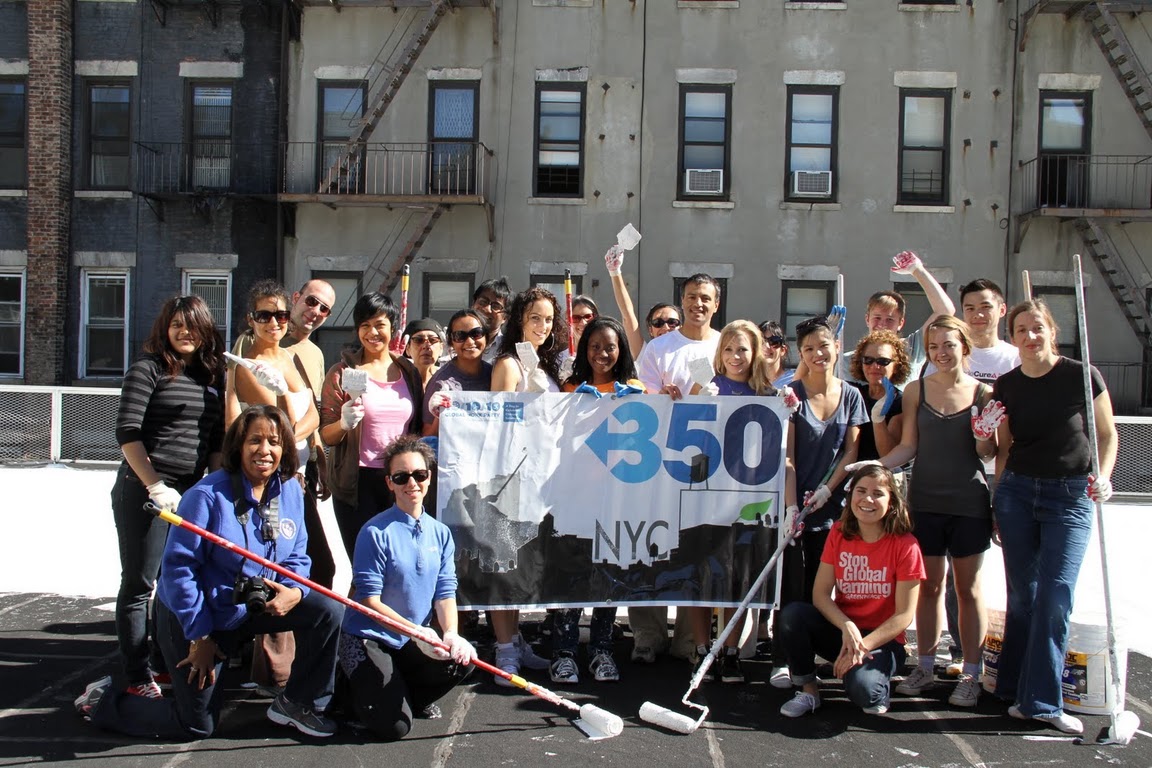
In the fall of 2010, inspired by 350.org’s 10/10/10 Global Work Party, several groups collaborated with NYC government agencies to paint the roofs of four nonprofit facilities white: the Bowery Mission, Harlem’s Democracy Prep Charter School, Fountain House in midtown Manhattan, and the SCO Ottillie Campus in Briarwood, Queens. Organizers and volunteers came from StopOilNYC, White Roof Campaign, White Roof Project, Manhattan Young Democrats, 350.org, Greenpeace, OxFam, NYPIRG, and New York University student environmental groups.
Projects like these will not only make real improvements in lowering energy use, but can help recruit more partners and volunteers, and set up other local sustainability initiatives. To find potential nonprofit facilities with roofs to paint in 2011, we’ll start with the Council Members we contacted who were eager to refer us to nonprofits in their districts.

The matter of paying for the paint creates an opportunity. Instead of seeking corporate donations, we’ll work with the nonprofit to organize winter events to raise the money locally. Besides gaining local supporters and media attention, these projects allow environmentalists from outside the neighborhood to wield rollers and brushes alongside volunteers from within it.
For the full proposal for neighborhood leaders, and flyers from the City Cool Roofs program, go to www.whiteroofcampaign.org/ or Beyond Oil NYC.
Green neighborhood Trojan horses
With positive relationships already established between organizers and the nonprofit contacts seeking to fund their white roof project, we can introduce the next stage of the project. What are the overlaps between community needs, and the green services that are already available in the City but not adequately distributed? Usually centered on promotion of energy efficiency programs, government agencies regularly set up panels at which representatives pitch several programs to neighborhood leaders and residents.
- Are energy bills too high? Con Edison and NYSERDA, the State agency which incentivizes energy efficiency retrofits, offer a number of cost-cutting energy efficiency upgrades for homes and businesses.
- Do neighbors want more fresh fruits and vegetables in local stores? Green markets? Many nonprofits offer gardening classes, and want to help residents convert lawns and yards into vegetable gardens, and set up community gardens and composting areas.
- Are there complaints about inadequate mass transit service? Let’s find the advocates and alternatives who can address this community need.
- Job training providers, for both green and conventional programs.
- Food assistance and public health programs for those in need.
White roof project organizers can introduce community leaders to these other programs, making their outreach efforts easier, and reinforcing the new green network forming within the neighborhood.
This might work something like a Transition initiative. Here, the organizing process would start, not with a common education process around climate change and fuel depletion, but with unthreatening projects that have something to offer a broad range of participants. Should the ingredients come together – and external events reinforce the importance of more sustainable and resilient neighborhoods – the project may be able to recruit more volunteers, develop a network, and evolve in other productive directions.
Some questions on which you might like to comment:
Would you like to intern, volunteer or collaborate with a white roof project?
Are there happy attractors and green Trojan horses better than white roof painting?
Or ones that you like better that you would like to collaborate on with us?
What's going on with Transition initiatives in the United States, and what can we learn from them about how to make NYC more sustainable?
***
The role of grassroots sustainability organizing
Changing the sustainability discussion is important, as a means of getting people involved in practical, effective efforts to make their communities more sustainable. Discussion must lead to action. Otherwise, mere talk, no matter how well informed and well intentioned, is cheap.
Many activists responded to failure of national and international climate change legislation by turning to decentralized grassroots action. Joining the invitation from 350.org to a global work party on 10/10/10, people at over 7,000 events in 188 countries, got to work on the climate crisis. By digging community gardens, installing solar panels, planting trees and more, they aimed to send a message to political leaders: “if we can get to work, so can you!”
This is clearly informed by the Transition method of community organizing, now being applied in many UK towns and cities, as described in the New York Times. Neighbors educate themselves about climate change and fuel depletion, envision their community having successfully adapted twenty years in the future, and then work backward, planning what needs to be done to make that future possible. Collaborating on local projects, participants begin creating that future piece by piece.
In large cities, environmental and sustainability groups organize presentations and films all the time, but without recruiting partners who live in close proximity, and who share permanent social networks. However, many city residents are very involved in neighborhood concerns through countless civic groups.
Seeking happy attractors
Can sustainability initiatives be distributed through well-established local networks? Perhaps – if one can find initiatives appealing enough to inspire different sets of volunteers, who usually operate in different realms, to collaborate. What initiatives might fill this role? What initiatives offer enough benefits to be easily sold, implemented, duplicated and expanded? What will motivate environmental activists, neighborhood leaders, and additional volunteers and partners? The initiative must:
- inspire climate change and sustainability activists to volunteer themselves and promote it to others;
- offer clear cost benefits or savings, without considering environmental benefits;
- be easy to understand, describe, and see as positive;
- must be quick, inexpensive, and simple enough so volunteers can dive in and successfully accomplish projects, inspiring others to follow; and
- must offer enough public relations benefits to local partners and civic groups so that they have an incentive to expedite these projects.
One comparatively simple way to lower the City’s air conditioning use in the summer happens to fit all these requirements. It is a happy attractor: there is nothing distressing about it; it is empowering, patriotic, and it distributes goodies all around with minimal cost. It offends no one, has no enemies, and is welcome at parties. It is a great conversation starter. If you can think of other programs like this, please let us know immediately!
Painting roofs white
Black surfaces absorb more of the sun’s heat than white surfaces. Each summer, NYC’s many flat, black tar roofs can get up to 100 degrees hotter than outdoor air temperatures, increasing the amount of air conditioning required to cool the building below. This means more energy used, more carbon emissions, more pressure on the City’s already strained electric grid, and higher risk of blackouts. By radiating that heat to their surroundings, black roofs contribute to the heat island effect, whereby urban areas can reach temperatures up to 15% hotter than surrounding rural areas.
White roof coating projects are an important part of NYC’s climate change response, with the NYC Cool Roofs program. “Reflective rooftops are a simple yet powerful tool in the fight we have been leading against climate change,” said Mayor Bloomberg, and a means to channel “the power of our volunteers to address some of the City’s greatest needs.” U.S. Energy Secretary Steven Chu has called for “white roofs everywhere” to help fight climate change.

In the fall of 2010, inspired by 350.org’s 10/10/10 Global Work Party, several groups collaborated with NYC government agencies to paint the roofs of four nonprofit facilities white: the Bowery Mission, Harlem’s Democracy Prep Charter School, Fountain House in midtown Manhattan, and the SCO Ottillie Campus in Briarwood, Queens. Organizers and volunteers came from StopOilNYC, White Roof Campaign, White Roof Project, Manhattan Young Democrats, 350.org, Greenpeace, OxFam, NYPIRG, and New York University student environmental groups.
Projects like these will not only make real improvements in lowering energy use, but can help recruit more partners and volunteers, and set up other local sustainability initiatives. To find potential nonprofit facilities with roofs to paint in 2011, we’ll start with the Council Members we contacted who were eager to refer us to nonprofits in their districts.
For the full proposal for neighborhood leaders, and flyers from the City Cool Roofs program, go to www.whiteroofcampaign.org/ or Beyond Oil NYC.
Green neighborhood Trojan horses
With positive relationships already established between organizers and the nonprofit contacts seeking to fund their white roof project, we can introduce the next stage of the project. What are the overlaps between community needs, and the green services that are already available in the City but not adequately distributed? Usually centered on promotion of energy efficiency programs, government agencies regularly set up panels at which representatives pitch several programs to neighborhood leaders and residents.
- Are energy bills too high? Con Edison and NYSERDA, the State agency which incentivizes energy efficiency retrofits, offer a number of cost-cutting energy efficiency upgrades for homes and businesses.
- Do neighbors want more fresh fruits and vegetables in local stores? Green markets? Many nonprofits offer gardening classes, and want to help residents convert lawns and yards into vegetable gardens, and set up community gardens and composting areas.
- Are there complaints about inadequate mass transit service? Let’s find the advocates and alternatives who can address this community need.
- Job training providers, for both green and conventional programs.
- Food assistance and public health programs for those in need.
White roof project organizers can introduce community leaders to these other programs, making their outreach efforts easier, and reinforcing the new green network forming within the neighborhood.
This might work something like a Transition initiative. Here, the organizing process would start, not with a common education process around climate change and fuel depletion, but with unthreatening projects that have something to offer a broad range of participants. Should the ingredients come together – and external events reinforce the importance of more sustainable and resilient neighborhoods – the project may be able to recruit more volunteers, develop a network, and evolve in other productive directions.
Some questions on which you might like to comment:
Would you like to intern, volunteer or collaborate with a white roof project?
Are there happy attractors and green Trojan horses better than white roof painting?
Or ones that you like better that you would like to collaborate on with us?
What's going on with Transition initiatives in the United States, and what can we learn from them about how to make NYC more sustainable?
Subscribe to:
Posts (Atom)